Podcast Ep218 Leah & Grace
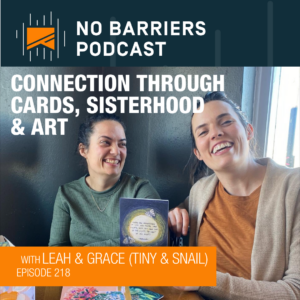
Didrik Johnck: Have you ever wondered what it's like to build a thriving creative business with your sibling? What happens when life throws a curveball? Can art and entrepreneurship survive a life-altering accident? How does a dark sense of humor, a handful of greeting cards, and relentless optimism change the way you connect with the world?
And can facing the unimaginable actually deepen your ability to inspire others? Our guests today are sisters Leah and Grace, AKA Tiny and Snail, and let's get into it. Oh yeah. Welcome to the No Barriers podcast hosted by Erik Weihenmayer. I'm producer Didrik Johnck, and we're glad you're here.
Erik Weihenmayer: It's easy to talk about the successes, but what doesn't get talked about enough is the struggle. My name is Erik Weihenmayer. I've gotten the chance to ascend Mount Everest, to climb the tallest mountain in every continent, to kayak the Grand Canyon, and I happen to be blind. It's been a struggle to live what I call a No Barriers life, to define it, to push the parameters of what it means.
And part of the equation is diving into the learning process and trying to illuminate the universal elements that exist along the way. In that unexplored terrain between those dark places we find ourselves in and the summit exists a map. That map, that way forward, is what we call No Barriers
Erik: Hey everyone, this is Erik Weihenmayer. Welcome to the No Barriers podcast. So I'm really excited about this interview because a lot of times we have folks with disabilities or, you know, barriers that people face, and they're athletes and they've done all kinds of like physically heroic things.
But, you know, No Barriers is so much about art and music and writing and all kinds of ways that we express this No Barriers life. So Leah and Grace, you guys are so unique in terms of your story. I'm really excited to talk to y'all
Grace: thank you for having us
Erik: yeah, I should also say that this is during... You both have young children or babies, right? And so this is nap time, so if we hear some, some squealing in the background, it's, you know, it's just the life of a working mom, right?
Grace: Exactly. Yep, you nailed it
Erik: So you guys are a team and Leah, you're kind of the, I guess y- you're always described as a little more the artist, and Grace, you're more the detail-oriented, kind of the business side of the relationship. Is that accurate?
Leah: Yeah
Grace: Yeah. We're, we're both
Erik: you're both artists. Yeah
Grace: right. But yeah, Leah, I just
Leah: I went to college.
Grace: Yeah, I went to college for four years for art. I'm just, amazingly passionate about it. And, um, Grace is, I don't know, more, yeah, detail-oriented. She's kind of up for whatever role she needs to fill too.
Leah: She does our photography. I am terrible at product photography, but Grace is like, just nails it.
And, uh, so I don't know. We just we both kind of fill in wherever we need, which is really cool, where we have a lot of complementary skills
Erik: 'Cause Grace, you also paint and illustrate as well, right? Some of the designs are yours, right? Even though you didn't go to art school, right?
Grace: Yeah, exactly. Yeah, so it's really fun. I contribute when I can. But yeah, when I describe our company to people, I tell them Leah was just given a true gift, just, like beyond my wildest dreams. And, it's amazing to see like the work that she consistently produces. It's just at another level.
So I'm excited to have some cards in our collection, and sometimes we collaborate. Like a couple of our best sellers are actually collaborations where I've done some of the art, and then Leah also has done some. And through the magic of, I guess like digitally merging those two things, it creates a really amazing card and piece of art.
So that's really fun. but yeah, some... A lot of the collections are purely Leah.
Erik: Tell me
Leah: Or like a lot of the times, a lot of the times Grace will have an idea, and then I'll turn it into something or
Erik: Yeah
Leah: something like that. we often collaborate on like the wording on the cards and things like that
Erik: I did my homework and, had my partner checking out all your beautiful designs and everything. She's just saying they're stunning. But, so I wanna learn, like from a blind guy's perspective, more about your collections and things like that. So tell me about something that you guys collaborated on.
What was one of the ones where you kinda merged your artistic talents together?
Grace: Yeah, one of our best sellers is called, Stardust and Fireworks, and the phrasing on it says, "You're a stardust and fireworks kind of wonderful." And, Leah drew this magical little camping scene, and the night sky and some of the silhouettes of the trees. But as she was working on the fireworks, she was, she just couldn't get them to quite look loose enough and,free, spontaneous.
And I am great at that 'cause I just whip things out and, yeah, I'm self-taught for art. So I worked on some fireworks, and we merged those two together and it's a, it's been a best-selling card from the very beginning
Erik: That's so cool. You have all kinds of collections. you have this, collection on golf I saw. Are you guys gol- Like, how do you decide? you just, do you, are, is it, they say write what you know, I'm, paint what you know. is it, do you, are you guys golfers, or do you just say, "There's a ton of golfers out there, so we have to have a collection on golf"?
Grace: You know what? My, so I'm married to a golfer.
Erik: Ah, gotcha.
Grace: yeah, not just as a hobby, it's his literal career. So he is a, a director of golf at, a country club in Milwaukee.
Erik: Got it
Grace: so anyway, I've been surrounded by golf ever since I married him. neither Leo vi- or I grew up with any golf, and we actually grew up, our dad, he loves gardening, and our mom would always say, "Oh, thank God your dad's not a golfer." And so when I was 13 years old, I made a list of qualities that I wanted in a future partner, and I said, number seven was does not golf. And then I fell in love with somebody who literally golfs every day. Or teach, yeah. he d- he doesn't get to golf every day, but he's around it every day. So anyway, I, um, I had made these cards years ago just as a special gift specifically for Bobby, and then finally we thought, "Well, we have these designs.
Why don't we try selling them?" And people have been really excited about them, so it's fun. It's very niche and not what we typically do for cards, but it's been fun.
Erik: My daughter's an animal fanatic. She just, wants to be a veterinarian, and she's going to school. So your, uh, bone-jour, um, one might be good for her, I think. it's a
Leah: I love drawing
Erik: bone-jour. Yeah, I like that. Also flamingos. What's going on with flamingos? I... She's... My daughter also loves flamingos.
cool animals. Yeah, I just, I don't know, I love painting birds especially. they're just so beautiful, Yeah
Leah: in terms of dogs, I actually, have one children's book out there. It's called "Best Day Ever," and
Erik: I saw that. Cool
Leah: yeah, it's about a boy in a wheelchair and his dog. It's told from the dog's perspective.
And it's really sweet, very sing-songy, and, yeah, I illustrated it about a year after my accident happened, six months or a year after, and, um, it came out in 2021.
Erik: Good. We'll promote that for sure. I bet that's beautiful
Leah: but I just love doing the dog's expressions and yeah, so I, yeah, it's one of my favorite things.
Erik: Now, why did you guys originally decide to go into business together as sisters? I mean, because that could be a fantastic partnership, it could be a disaster, you know? I ride a tandem bike with my partner and they call them the divorce mobiles, Sometimes if... so yeah, what was the original thinking there?
Why are we a good team? Why you
Grace: Leah, do you wanna go for it?
Leah: Sure. Well, we grew up pretty good friends, and we really enjoyed working with each other, like on school projects. I think we, we were like three years apart in school, so we weren't always collaborating, but when we did, I thought it was fun. And then after we both graduated from college, we were trying to make it work.
I was trying to make it work as an artist, and Grace was trying to work it, make it work, selling greeting cards that she had hand-painted on Etsy. And I don't know, we were both pretty lonely because I was living really remotely in Kentucky, and Grace was moving north-south with her husband who, had to teach golf in seasonal weather.
And so yeah, w- one day we were talking on the phone and she was describing how her wrists were killing her from having to paint all of these individual cards,
Erik: and I just said, "Grace,I went to school to learn how to digitize artwork and reproduce it and things like this. Like, let me be your hands and you can be my brain, and we'll make it work."
Leah: And
Erik: Leah, you don't get carpal tunnel when you painted?
Leah: I don't know. I don't think my wrists are quite as prone, although I have experienced some, wrist issues with all of the, not only the art and the computer work, like editing videos, but also just pushing around a wheelchair all the
time. So I do have to be pretty careful about that now.
Erik: Yeah. Has the business brought you even closer together?
Leah: Definitely
Erik: for sure. Gr- I think especially, yeah, as a- as adults, I think it gives us such a reason to collaborate every single day. when you're kids and you're living in the same house, and you're good friends, you're constantly around each other, you're playing with each other, you're doing art side by side.
Grace: But once you go to college and then you're creating your own adult life, even if you feel so fond of your sibling, I think you could go for a week, two weeks, without really having a conversation with them or checking in, especially if you don't live in the same town, which we sadly do not.
And so yeah, having this business, we are in constant communication, and it's so fun. it's a beautiful way to be connected. and I think for us, it's really worked. I see what you're saying, where it could be totally disastrous for some people who are related to be in business. But yeah, for us, it almost...
It's like we got to skip over the part where you're trying to figure each other out
Erik: Right
Grace: trying to have difficult conversations, but you're not quite sure how to approach it. It's not that we don't have difficult conversations, but I think a lot of them we bypass just because we are on the same page with so many things.
And then when we do need to have a harder conversation or we don't quite see eye to eye, there's just such a bank of trust that, we totally love each other, trust each other, want the best for each other and our business. And so having that security, helps us, I think, weather any little complications that pop up.
Erik: Leah, though, you must have had a couple arm wrestling matches, right? Or
com- come on, let's get juicy with it.
Leah: I would win, but, no, I don't know. In the beginning in, like, our conversations, I feel like, we really were more concerned of, like, whose style is it gonna be? And then once we started working together and, like, actually making decisions and making a product, I think, like, all of that power struggle went out the window, and we just were focused on
Erik: Yeah
do we make this work together? Leah, how did you know, w- at what point did you know that you were a good artist? You know what I mean? Because, a lot of people, they're good drawers, right? And, but they, it just stays a hobby. Like, when did you th- or I know I'm good enough to make a living doing this, and this is what I have to do"?
Leah: I've loved art since I was, like, three years old probably. I remember, an illustration I did in kindergarten, for a friend, and I just felt very proud of it. And, like, all through elementary school, people encouraged me. There was a lovely old man who sat on the playground, and I'd sit next to him, and he'd, whittle a, a stick.
And he was like, "Someday you're gonna be a famous artist. I would love for you to have, have a piece of your artwork, so would you draw me something?" And I drew him a wolf and, in pencil, and But moments like that as an art- or, as a kid growing up loving art, I think just matter so much, for, encouraging them to keep going.
Erik: So you not only have to be good at it, you have to love it so much that you can't imagine doing anything else with your life, right?
Leah: Yeah, I don't know. I guess when I was trying to figure out what I was gonna do for college, I was like pretty good in school over, all around. I really liked biology too. I could probab- you know, I could see myself going into medicine or something. But I, in high school, like art class, it was like the one hour where no matter what happened during the rest of my day, I could just sit down and it was therapy for me.
And so when I was given the option like, "Oh, you could study art in college," I'm like, "Oh my goodness. Yes, please. Like I can do this all day long? Yeah, like that's what I wanna do."
Erik: You know what I think is interesting though, like Leah is such a curious person and just a lifelong learner, and sometimes I have compared her to a hummingbird, especially before her accident. Like she was interested in tiny houses and design and architecture and medicine and sustainability and art.
Grace: Like just a million things. And it was really interesting because when her spinal cord injury accident happened, we had so much time to process together as she was in the ICU for 29 days. And, I remember one of those conversations she said to me, I feel like I was waiting at the train station and this train was saying, 'Get on.'
Like, this is the art train and I don't want you to miss it." And she's like, "My accident almost forced me off the platform and onto this train, and now I know that my driving purpose is to create art in the world." And I have never forgotten that conversation, and I really do feel like Leah has taken this extraordinarily hard event, that continues to make her life very difficult in so many ways.
but she saw... She's almost been like an alchemist with it and just realized "Oh, okay. Now there are certain things that I was interested in before that I can't do anymore. Like I can't be, creating cedar shingles for an amazing tiny house, but I have my iPad and I can create these beautiful worlds within a greeting card and just really dive into that."
So anyway, yeah, it's pretty amazing h- the path that it's taken her.
Didrik Johnck: Hey listeners, this summer has been going off with No Barriers events so far. Our team has loved connecting with so many of you. We've got one mega event to cap off the summer on September 12th at Winter Park Resort in Colorado. It's our annual What's Your Everest? And it's an all-abilities mountain adventure.
Start the morning with breakfast and connection, then head out together in small teams to hike three point nine miles to the summit at a pace that works for you. Adaptive equipment is available so everyone can take part in the journey. At the top, take in the views, then ride the gondola back down and celebrate with lunch, music, and community.
With more than two hundred participants of all ages and abilities, this is more than a hike. It's a chance to push your limits, connect with others, and be a part of something unforgettable. Head to nobarrierspodcast.com to learn more and register.
Erik: We could do a whole podcast just on this piece, this alchemy piece, 'cause we talk a lot about this at No Barriers. One, I'm thinking about this computer teacher I had who was blind. He taught me how to use computers, YeahWS, and all these cool technologies, and he said by actually going blind he, he was interested in a million things and he was a little bit of a troublemaker, and not that you guys are that, but, he said it...
Going blind limited his pathway in a way that made him realize that this was the path that was clear to him. So it's interesting that you say that, like, having your accident, Leah, put you on the train rather than shoved you off of the train. it's so counterintuitive,
Leah: it's a really important message for everyone, right?.
Well, yeah, so we had started Tiny & Snail about a year before my accident
Erik: Fledgling company, you get in this horrible construction accident. A forklift essentially falls on you, and my God, out of the blue, right? so insane what happens to us in life, right? Yeah. Everything changed within 10 seconds, Yeah
Leah: And, but two weeks before then, I was working putting rebar down in a foundation in 90 degree weather and thinking, "Oh my gosh, when am I going to be able to transition like part-time to Tiny & Snail?" and then when I woke up in the hospital, I was like, "Oh.
Erik: Oh, I guess right now." And I don't know. I- it's, yeah, like don't expect freedom to come in such a harsh manner sometimes, Yeah, it's like you're standing on a beach and there's like, you're dipping your f- toe in the water, and the a- the, the accident actually makes you plunge in. So fascinating. Uh,
Leah: Mm-hmm.
Erik: but you were s- it w- yeah, go
Leah: woke up-- Well, this is a pretty incredible story too. so when I woke up, the very first question I finger-spelled into Grace's hand was, "Can I still draw?" begi- you know, the doctors had told me I was paralyzed and I wouldn't be able to walk or run again. And, so that was, like, the very first thing on my mind.
And amazingly, the answer was yes, because my spinal cord injury happened at, a low enough level that I still have full function of my arms and hands. And not that I... I think, even if I had a higher up spinal cord injury, I'd probably still be trying to make art, but it would just be very different
Erik: It'd have to be a different adaptation, yeah
Leah: Yeah, exactly.
Which, as we're talking, like, maybe that would be okay too. But, I-- it was just, it just felt like life was very clear to me. Like, no, this is what you're doing now. And, I, your brain was spared, your hands were spared, just go
Erik: And Grace, you, uh, jumped on a plane right at the beginning and were there in the ICU with Leah. Leah, you're on a breathing tube. this is very serious, right? Very serious accident. What was that experience like in the beginning? it must have just kind of... I guess terrifying would be the short answer?
Grace: Terrifying. It was such a crucible, and when my mom called me with the news, oh my gosh, I just sobbed, like sobbed for hours. Because it was very uncertain whether Leah would live or die. she was hanging by a thread, and that first surgery, I think it was 13 hours long, and that was not the only surgery.
It, the, those whole 29 days in the ICU, we would just pray for boring days, But like, you would have one boring day, and then the next day it would be like crisis mode again. It's like, "Oh my gosh, she has an infection in her spinal cord or in the, surgical area, and she needs to go in for surgery again."
And you're watching my parents sign these papers saying which I think is signed for any surgery. You know, basically like, "We know this could go wrong, and she could die." But it just felt so perilous so much of the time. And at the same time, also just intensely holy. It like, that room was so full of the most important things in life, just each other, family, the support of a community, food being brought to us, cards pouring in to the mail for Leah, holding each other's hands.
singing, dance parties, listening to music. Like
it
Erik: parties in the ICU, I understand, right? Gotta move those arms, right?
Leah: Oh, yeah.
Grace: We had
Leah: I think joy.
Grace: had
Erik: you, I heard
Leah: Yes, it was definitely the most fun room in the ICU.
Erik: Yeah, you have a sharp sense of humor, right? Like, you have a climber sense of humor, right? Climbers are so dark. Like, we'll say, things like, "If I live through the day, this will be the best day of my life," Just, it's just a lot of dark humor, right? And so, uh, you, I guess you were making people laugh, and in a way I guess that's therapy, right? just like, "Hey, despite the seriousness of this, we're gonna laugh," and, that's a way of controlling your mindset and your environment, right?
Leah: Mm. Yeah,
Erik: Yeah,
Leah: so. I think some of the drugs also, got rid of a filter, so
Erik: Yeah.
Leah: But
yeah,
Erik: write into her hand, some jokes, or type on the
Leah: Oh, yeah. Yeah, well, uh, very-- So at the beginning, I was finger spelling, and I probably was cracking some jokes even then. But then I started, like a friend, an artist friend brought over some construction paper and permanent markers, and I couldn't even see anything.
My vision was so blurry, and I don't think I was really sitting up in the bed, so I was just like, blindly scrawling this really bad, shaky handwriting. But it was enough that, to communicate and, Yeah,
so
Erik: remember anything she wrote? Do you actually remember any of those things?
Grace: We saved some of it. I took photos of it. yeah, one actually became a card. I think she wrote, "Where you find magic, dive in." And, what e- in terms of jokes, I really remember there was one moment where there was this sweet nurse, and he just had so much compassion for Leah, and he had to give her a shot of some sort, and she was paralyzed from the chest down, and the shot was happening in her thigh, and he went to give her the shot, and then Leah goes, "Ow, oh my gosh."
And this poor guy,
Erik: I bet he jumped.
Grace: jumped, jumped back, and she's like, "I'm just kidding. I'm totally paralyzed." And,
uh, it was just... Ah. Oh, if only.
Leah: ja
Erik: you say you felt like a rotisserie chicken on a bed of ice?
Leah: Oh yeah, I did. I think my illustrator brain was, like, constantly s- seeking ways to describe how I now felt, because I don't know if you're aware of this, but sometimes people with spinal cord injuries has a, have an immense amount of pain. So like, even though I can't feel anything, sensation-wise, like below my line of paralysis, which is about like chest level, like every cell in my lower body is like screaming out right now, and it only goes away if I'm sleeping. and so I had no idea that was a reality for some people who are paralyzed. And so, like waking up with that and trying to describe
Erik: Yeah,
Leah: how my body now felt, yeah
Erik: Yeah, and then also feeling like you're sitting in ice water, I think. You know, I've interviewed folks from Unite To Fight Paralysis and, they've told me that's like a major thing they're trying to work on right, right now in terms of research.
Leah: hope
so.
Erik: yeah, how to get rid of that, that horrible, chronic pain, right?
Yeah, nobody-- people who are not paralyzed or not disabled do not understand that.
Leah: Yeah, I had no idea. And,I've tried basically every medicine for it under the sun, and nothing really seems to help all that much. but, a- again, like this is where mindset comes in. I think that I've adapted because of that pain. I think that it really ends up in my artwork now, and trying to distract myself with my business and creating art that can help other people feel better in their pain.
I think that it just, it does make it, the art a lot stronger probably.
Erik: It helps your recovery and your own self when you have a purpose, right? you, sounds like you love drawing so much. You know, your first question is, "Can I still use my arms and draw?" So, like, throughout the healing process, you're trying to get back to drawing, right? So that's gotta be incredibly, motivating and speeding up, in a way, your recovery
Leah: Yeah. Like I did draw quite a bit in the ICU, and it was really, at first my handwriting was pretty shaky. But I assume that, yeah, probably using hands sped that along. And yeah, just mentally gave me something else to kinda cling to
Erik: You also got a lot of letters. You,like a lot of greeting cards, which is, I found rather ironic, of course. You guys are in the, the greeting card business, and then you're getting thousands of greeting cards. What was that like? Being on the receiving end of greeting cards, and what did you learn from that?
Leah: It was really cool. I think be-
Erik: lot
Leah: Yeah, before my accident happened, I think that always thought, greeting cards were nice and, a fun way to connect, but I didn't really realize the power that was available in them. But I just think that, People are able to be really vulnerable when they write to somebody.
And, I-- it was a lot like I was Tom Sawyer at my own funeral, hearing all of these really nice things that people had to say to me, and I think that just, reshaped my brain in many ways. And I think that still is some of the fuel that I have now. . Yeah, like I've just been given so much by other people and, I feel like I have to pay it forward somehow. Another thing was waking up in the ICU and receiving all these greeting cards. Like I thought, well, my pain is so visible. Like what happens to people whose pain is invisible?
How can I help make sure that they also get support like this? And so like that's been part of the mission I think of Tiny and Snail now too.
Erik: and you guys wrote that the business in a way became a life raft, like another piece of, therapy or healing too, right? Or just maybe the drive of wanting to have this beautiful, important business, became part of the process, right?
Grace: Oh, completely. The fact that we, we had laid the foundation for a year of, starting to build this business. But to have that for Leah to kind of look towards and say, "Oh, my life might look like a lot different right now, but I have this thing that I can jump back into and be an employed working person," that really suits her skills so well.
It was pretty beautiful. And yeah, now we, on the back of every card, we have our story, which people have commented that they really love that. And some people who send our cards say, "I always..." I write in the card, "Please look at the back of this card and look at their story." And I just, I think that if, if you're lucky to live long enough, you are going to experience some type of intense suffering.
And for some people, it might look like going blind. For other people, it might be being paralyzed and, or losing somebody who just you thought that you could never live without. there's just a million ways that suffering takes place, but it comes for everyone. And so I think having stories of resilience that you can look towards is really helpful for people.
And so I just love that our company can provide that light- lighthouse to other people as they go through their own things.
Erik: Yeah. I have this friend, Timmy O'Neill, w- and I kayaked the Grand Canyon with him. He was one of my guides, and he's really into handwritten notes. He did this thing where he wrote a handwritten note every da- every day for an entire year to different people telling them how important they were to him, and it was all written, with a pen and paper.
Nothing digital. And that seems like a trend, at least in my community, right? So Grace, obviously being in this business, you're aware of that trend, right? That throwback from digital back to analog, right? And so is that a big piece of what you guys do?
Grace: Oh, for sure. I think nothing can beat a handwritten letter. That's one of the things, honestly, that comforted me when Leah was, on death's doorstep. I thought if she dies, it will be absolutely devastating, but I know that I have said exactly how I feel about her. She knows exactly how I feel about her because I've written it down, and I've said it verbally.
But like, I just knew that she had those words in her being. And so I think that's so important. It not only impacts the receiver of the note, but it really works on your own spirit when you handwrite a note or a letter to someone. Um, but yeah, I think there's such a ... There's just such a pull towards things that are tangible, that ground us, that slow us down, because today we're just being bombarded by
Erik: Thousands.
Grace: sugar.
Erik: Yeah.
Grace: It's just
Erik: molecule is called
Grace: yeah. And it really does not serve our ultimate happiness. So yeah, it's pretty
beautiful to
Erik: you can hang it on the refrigerator, you can keep it in a scrapbook, right? You can look at it 20 years from now and
Leah: yeah,it's different, right? Yeah.
Grace: Yeah. It's so different than
a text
Leah: nostalgia for that day, when your grandmother would write you a beautiful note on a beautiful card, Yeah, for sure
Erik: Now you guys both have babies, right? L- Leah, it- b- tell me if this is too personal, but ha- being a, a quad or excuse me, a para, having a child is like, pretty miraculous, pretty amazing
Leah: Yeah, one of-- another one of the questions that I asked when I was in the ICU was, "Can I still have kids?" And I think that, the accident, like almost dying... I, before my accident, I was like so afraid of a c-commitment. And I think that I was afraid to, yeah, just in a way, start my life. Like I had been in a relationship with a guy for several years, and I was just afraid to move on to the next step.
But as soon as I had my accident and then he showed up in the ICU, I was like: Oh, man. Like life is so short. Uh, I can't really take anything for granted. And so, uh, we got engaged in the ICU
Erik: Oh my gosh
Leah: yeah. And, uh,
Erik: That sounds like a movie
Leah: it was, you know, they really should make a movie about it. But, yeah,
then we got married like, yep,
Erik: Ellie, and Grace, what's your b- ch- kid's name?
Grace: Leah has two and I
Erik: You have two now. Oh my God, I missed
Grace: Yeah. We might need to update our website.
I don't know.
Erik: what's going on around here? Yeah, gotta get those out there. So w-
Grace: once you have one kid, yeah
Erik: yeah
Leah: I have Ellie and Levi. Levi is 17 months right now.
Erik: Oh
Leah: He's just an absolute handful. Um, so yeah, it's a little bit terrifying as a parent in a wheelchair, when he's like climbing on things because I'm not, able to scoop him up out of those places all the time.
Erik: Yeah
Leah: it's, But I do think that being a parent in a wheelchair, like, teaches your kids a little differently.
I think, Ellie is pretty cooperative and helpful because I've just asked her to do things for me ever since she was
Erik: Yeah.
Leah: Levi's age, basically.
Erik: like having a blind dad. Yeah. they get, they grow up and they kind of have more empathy, I think, to all the ways that people live, right? Yeah. Grace, you, I don't wanna leave you out. Tell me about y- your kids
Grace: So I have a three-year-old. He just turned three on July 4th, so very celebratory fireworks kind of birthday, and his name is Everett. And then I also have little Leo, who is 21 months old. Um, so he's just a few months ahead of Levi, and we're constantly getting them confused, Leo and Levi. And,
Erik: they all get together and pl- they, and know each other like you guys? Are they gonna go into
Grace: every summer we try.
Oh,
Leah: Maybe
Erik: Nice.
Grace: it's gonna
Leah: I can't wait to see them together this year
Didrik Johnck: No Barriers would like to recognize and thank CoBank for their support of No Barriers. Since 2016, CoBank has provided access to our life-changing programs for veterans and family caregivers from rural communities. CoBank is one of the largest private providers of credit to the US rural economy. The bank delivers loans, leases, and other financial services to agribusiness, rural infrastructure, and farm credit customers in all 50 states.
If you live in a rural community or work in agribusiness, we want you to know that CoBank supports this kind of holistic support for your community
Erik: I also like this, tradition that you guys have, this ritual August 14th, which is Leah Live Day. a- and you guys talk about it in terms of not like s- commemorating this terrible thing that happened, but celebrating perseverance and
Leah: Mm-hmm.
Erik: adapting and living through it and having a life, right?
Leah: Yeah
Erik: That's really powerful. What do you guys do? Play cornhole?
Leah: Eh we've come up with a few different ways to-- that we honor and celebrate the day, and we invite our, the people in our Tiny & Snail community to do that too. So one of the things is just, like, connecting with nature. if you can, put your toes in the grass and just really, like, be present.
another one is writing a card to somebody. And the day before my accident happened, I actually put three cards in the mail, and that was a miracle because I'm terrible at completing tasks sometimes, but
Erik: like an artist
Leah: yeah, for sure. I think that, yeah, just like seizing the day and writing to somebody that you love.
And then I was all about fancy drinks in the ICU because there was about 10 days where I couldn't really eat or drink anything. And so when I finally could, it was like revolutionary. Oh my goodness, it's such a blessing to be able to swallow. And so that's another thing that we, like to promote too.
Grace: And, telling people just try to stay off your phone today. It was kind of ironic because for a few years we launched a collection on August 14th on Leah Live Day. And then a couple years ago we thought, this is crazy because we're telling people, like, "Get off your phones. Be with the people you love.
Really be present in the moment." And here we are, like, answering customer service questions and, like, checking our email obsessively. So anyway, we've kind of, um, we still launch a collection in honor of Leah Live Day, but not on the actual day anymore, which has been a relief.
Erik: Good for you. That's important. Yeah. so Leah, you've been alluding to this and talking about this throughout the entire conversation, but did your accident and, the evolution that you went through as a person now with a disability push your art forward, like in terms of your depth, your compassion, in terms of like the things you, you think about?
Yeah, I think so a lot. Tell me how
Leah: Yeah. As I am drawing I think that I connect at a very spiritual level with the people that I'm making the art for. It's almost like beyond words. It's really hard to explain, I think. but I-I, if I hadn't been through something so hard, I don't think that I'd really be able to access that same level of depth of compassion for other people and their situations.
Erik: I c- I'm just grasping here. I'm trying to think about it. But like, you know, you have this thing that just taps into your soul, into your heart, right?
Leah:
Erik: and do you think that, things become deeper, you're able to tap into that place that maybe you didn't have as much access to, you know, as a able-bodied human.
Leah: Yeah, I think there is something with art. like this idea of the suffering artist. I don't know. I don't think it necessarily has to be true, but I do think that suffering does just make you connect with other people. And, I think that art is often that bridge of connection, and you discover that, like, um, yeah, somehow my specific case, feels like yours, even though they're totally different.
there's something in common between these two things, and, art can often be that
Erik: Yeah.
Leah: bridge. And sense, but
Erik: It a customer, we had a customer who emailed us a while ago and she said, "I ordered your cards. I haven't been able to cry in years, and I started flipping through your cards and I started to cry for the first time." And I think it just, like the depth of what Leah has been through, it shines through these cards.
Grace: Whether it's a joyful card or a, a sad card, it's bo- like, everything is so true. It, like you sense the authenticity in the art, which I don't think you necessarily are finding in your grocery star- grocery store card aisle. yeah, so yeah, it's really, like the comments that people give us about these cards is unlike anything I've read about other cards.
Erik: I mean, I'm biased, Of course. One of, one of the things we talk about at No Barriers that I find is that, w- we, w- we've said we're not always connected by, like, our triumphs, right? for me, standing on the summit pounding my chest. It's more like the connection comes from the barriers that we all face, the challenges that we face, like the things we've gone through.
Those are the things that counterintuitively connect us more than, you know, eating ice cream.
Leah: Mm-hmm.
Erik: And your, your art has obviously bled its way into, uh... Or, sorry, I should say your story has bled its way into your work, right? Into your art. you have all this really cool stuff like Keep Dancing or, Phoenix Rising From The Ashes, right?
So does your story become part of the business? Does it all get,integrated, woven together? And it... And I guess in a way, that would seem to me that, that makes a business even stronger, not that you're wishing, your disability on anyone else
Leah: Yeah. Um Pretty impossible to separate an artist from their physical condition,
Erik: Right. Yeah
Leah: or like from their specific reality. But yeah, I, when I was twen- 29 my accident happened, and then when I woke up, I feel like in many ways I felt like I was like 80 years old. So like, I, I just had this incredible depth of experience just handed to me.
I think life was just like, "Here you go. Make some art about it." And so like, yeah, I doubt that many 37-year-olds are creating art that 80-year-olds feel this deep connection to just because of differences in life experiences. But, yeah
Erik: But i- instead of ignoring that background, instead of ignoring that story, y- that story becomes part of what you guys are doing, right? And that's, that, I think that's so powerful
Grace: Yeah. We're both...
Leah: Oh, go on, Grace
Grace: Oh, I was gonna say we're both writers and poets as well, and, every Sunday we send out a newsletter that's just very open and oftentimes vulnerable with basically just stories about our lives, what we're going through, what we're thinking about. And, yeah, I think we're very open to authenticity and transparency and building a community that is real and based on real things and our real lives, and,it really seems to connect and resonate with other people.
So yeah, I think that we are pretty, pretty dedicated to being open about what we've been through and what we continue to go through. And that when you share yourself in an honest way, people share that back with you, and it really does create such a beautiful business. We've, we have met the best people through our company.
Just like card senders are really, really kind people, so kind of the ideal customers, honestly, to have.
Erik: Yeah. Well, that's so cool that, that you have this very difficult thing happen to you two and, and then it actually it's not like you wish this on yourself, right? But, like, it becomes part of your story. It becomes part of your No Barriers life, and, uh, I think that makes a very strong community and a very strong business.
And people see that authenticity, and they see that hopefulness coming through. It makes, it makes me feel like I wanna support your business because it's real. There's no bullshit there. Does that make sense?
Grace: Yeah. Thank you. I'm glad that shows through. Yeah
Erik: Yeah. Wonderful, guys. Sorry, that's my East Coast coming through, uh, guys. But
Grace: Oh, we're South Dakota. We say it all the time.
Erik: Thank for, for, for being on the podcast and, um, maybe we should do a, a No Barriers collaboration at some point. That'd be really cool.
Leah: Yeah
Grace: That'd be very cool. Yeah.
Leah: I know you. can't see it right now, but my shirt says, "You say relentless like it's a bad thing." And, it was a T-shirt that I got from a rehab place that I went to, QLI in Omaha. And I just felt yeah, like a badass coming onto your show today and
Erik: Nice. You guys are badasses. I
Leah: Yeah.
Erik: Yeah. All right. Thank you everyone. Thank you to you two. No Barriers to everyone.
Didrik Johnck: The production team behind this podcast includes producer Didrik Johnck, that's me, and audio engineer Tyler Kottman. Special thanks to the Dan Ryan Band for our intro song, Guidance. And thanks to all of you for listening. If you enjoyed this show, please subscribe, share it, and hey, we'd be thrilled for a review.
Show notes can be found nobarrierspodcast.com. There's also a link there to shoot me an email with any suggestions or guest ideas for the show. Thanks so much, and have a great day