Ep 220 Mike May
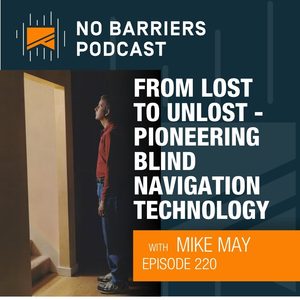
Didrik Johnck: Welcome, welcome to the No Barriers podcast hosted by Erik Weihenmayer. He'll be jumping on in just a sec. Today's episode is a deep dive into what it really means to navigate the world without sight with guest Mike May, a true pioneer in the space. We'll get into wild stories about building the first accessible GPS, hey, this is pre-Google Maps stuff, the role of AI in today's navigation environment, and the emotional rollercoaster of regaining vision after decades of blindness. Is it really the miracle the world thinks it is?
Whether you geek out over technology, love hearing about resilience, or just want to know how someone can ski 65 miles an hour without seeing the slope, I'm talking about Mike, of course, you are in for something special. All right, let's do this. I'm producer Didrik Johnck, and this is the No Barriers podcast
Erik Weihenmayer: It's easy to talk about the successes, but what doesn't get talked about enough is the struggle. My name is Erik Weihenmayer. I've gotten the chance to ascend Mount Everest, to climb the tallest mountain in every continent, to kayak the Grand Canyon, and I happen to be blind. It's been a struggle to live what I call a No Barriers life, to define it, to push the parameters of what it means.
And part of the equation is diving into the learning process and trying to illuminate the universal elements that exist along the way. In that unexplored terrain between those dark places we find ourselves in and the summit exists a map. That map, that way forward, is what we call No Barriers
Okay, good. All right. Should we start, Dee? We're good? All right, cool. Hey, everyone. Welcome to No Barriers. This is Erik Weihenmayer, and Mike May, I could talk to you for 10 hours. you and I have been friends for a l- yeah, we've been friends for a long time, but man, like, doing all the research on you, there's ... I'm diving into things that I never knew about you, and I swear I need 10 hours to interview.
Do you have 10 hours today free for
Mike May: why not? We might lose some of our listeners, but what the heck
Erik Weihenmayer: I'm gonna run this one into the ground. No way. Everyone's into long pod- podcasts these days. the other thing I was thinking, I was like brushing my hair this morning, and I thought, "Wait a second, I don't have to brush my hair for Mike." we could both be in like our, our Iron Maiden, tank tops, and we'll, we won't even know anything
Mike May: I should be wearing my, my Senegal jersey from the recent World Cup
Erik Weihenmayer: Oh, did you go to the World Cup?
Mike May: Yeah, in S- in Seattle I was using the one core tablet, so I, I had the best access ever 'cause I was feeling the activity on the field through my tablet. I was listening to the FIFA audio description, and I was in the midst of 68,000 people cheering. It was amazing.
Erik Weihenmayer: Wow. So fun. Hey, so you and I, got to know each other, I think, in the early days of No Barriers. you are an accessibility innovator, an entrepreneur, an athlete, and we invited you to come to our very first couple No Barriers, we call them summits, in Cortina, Italy, where they had invited a crew of folks with disabilities to this city to help them make their city more accessible and to build their own mindset around what's possible for people with disabilities, and that's kinda how No Barriers began.
And you did the coolest thing of the event, which was you led people on hikes using your accessible GPS technology. That was so cool. Remember? You were hiking past, like, waterfalls, and you were actually leading the tour
Mike May: Yeah. that was, in the day I wasn't the one to be climbing rock faces or, um, or rafting rivers, but I could do my GPS thing. And it,being independent as a blind person, is really depends a lot on knowing where you are, and with GPS you can independently do that. So we went out ahead of time and we marked certain turning points in the past 'cause, these things are not on the Google Maps.
Erik Weihenmayer: Right. And trails are rugged, and they split in half or in three different directions and, So it's way trickier, right, than navigating streets
Mike May: It is. And you, y-you also need to know something about is this a skinny path? is this a bumpy path? And so you can not only mark key turning points, but you can also provide little clips of information that describe the terrain
Erik Weihenmayer: And then the next, couple summits later we did something in Miami, and I think you led accessible GPS tours on a boat
Mike May: That there was, yeah, that was your ocean, um, No
Erik Weihenmayer: Yeah, our ocean journey. Yeah. Those were f- really fun days getting this whole thing of No Barriers started, and, you were a big part of it. and it's really cool that in the '90s you started Sendero Group and you created the first talking or accessible GPS. t- tell us about like the motivation for that. y- you were a kid, right?
You didn't have access to GPS as a blind kid. You're crossing streets, you're navigating cities, y- you know, you're trying to figure things out pre-technology. that must have shaped like a, the way that y- you realize like this is really necessary for blind people's independence and leadership, right?
Mike May: Well, I've always been hungry for information about my environment. 'Cause you think about it, with sighted people, they see print signs and they, you know, they mostly ignore them. For blind people, you don't have that option. You're sitting in a car, and you're dependent on what somebody tells you that you're passing, or maybe you remember from a previous trip.
So I was just really interested in knowing what is out there, what are the businesses, what are the landmarks, and realizing that I had a lot more options to be spontaneous than just turn-by-turn kind of routing, which is what you learn from an orientation and mobility instructor when you're a kid or when you go blind.
I wanted more than that. I don't-- It's not just about where to turn, it's what is between the turns.
Erik Weihenmayer: And how did you... What kind of systems? 'Cause I know you're a lot about workarounds, just,systems to figure things out. So what were some of your systems that you developed, and how did you do that?
Mike May: Well, in the early days it was pretty clunky because the, the GPS was being used by, commercial entities a lot by marine, outfits, and there were no street maps in the beginning. There was just points of interest. So before we had the ability to tell you where to turn, we had access to these 15 million points of interest, and the main thing for a blind person was, I want more verbosity.
The sighted person doesn't want to hear about everything that they're passing. It'll drive them nuts.
Erik Weihenmayer: Yeah
Mike May: I do want to hear about it. Maybe not all the time, but plenty of the time. So that
Erik Weihenmayer: if there's a cool bakery, like next to you that you might, I guess you'd smell it, but if you didn't smell it, you would walk by that every day and you wouldn't even know it was there. Yeah.
Mike May: And, you know, the techniques before GPS, I remember in Amsterdam one time walking along on my own, nice early morning and wondering what's around. And so I got really bold, and I heard this nice sounding high heels ahead of me, and I said, "You know, I'm gonna, I'm gonna be bold."
And said, "Excuse me, I can't see, and I'd love to know all the businesses that are in this block. Would you mind telling me what we're passing as we go along?" And so sure enough, in this nice Dutch accent, I got to hear play-by-play of all the businesses we were passing. That was pre-GPS. And, um, what a great way to exper- what a great way to experience it
Erik Weihenmayer: yeah. And so did that pre-GPS experience for you shape, like, why you thought GPS was so necessary? And that must have been a big driver for you
Mike May: it did. it goes back even further. my mother would drive me across the San Francisco Bay Bridge, and she was always telling me about what was out there. So I s- I think I got used to that. and when you've got a two, three-year-old kid, you're constantly trying to keep them occupied.
And one time she said, we were going across the bridge and there was fog, and she couldn't see anything. And she said, "There's nothing out there." And I guess I started fussing, so she just started making stuff up
Erik Weihenmayer: I've had people do that to me. And so she made, uh, she curated life in a more exciting way than was actually out there.
Mike May: Yeah, u-using her imagination
Erik Weihenmayer: And there's a circus off to the right. Oh my gosh, look at the elephants on the
Mike May: Yeah, yeah. On the Bay Bridge
Erik Weihenmayer: Nice. That sounds amazing. so tell me about the power of getting un-lost, because that's a phrase that you use quite a bit as you describe the technology and the purpose behind it
Mike May: this concept came to me when I realized some of the benefits of having accessible GPS. We're so often taught about don't get lost, memorize your routes. Go three blocks, turn right, go two blocks, turn left, go three blocks. So you're remembering, you know, three, two, three.
Erik Weihenmayer: Yes
Mike May: And I realized that with GPS and this database of points of interest and streets and everything, I could wander all day long, and then at some point I'd say, "Where's my hotel?" I set a route, and I go back to it. And I think the first time that really clicked for me was on a trip to Sydney, and you get there typically at 6:00 or 7:00 in the morning, and the hotel room's not ready yet, so I had hours to go wander around.
And this is before there were street maps, and so I set the hotel as my point of interest with my GPS, 'cause I could just say, just, "Hey, drop a breadcrumb here." And then I just went wandering through the streets, enjoying the day, and when I was ready to go back, I picked that destination. And since we didn't have street maps, we had to use what I call the getting warmer method.
Erik Weihenmayer: Ah, right
Mike May: And in that case, you just want the distance to your destination to be less. So it says one mile, a thousand feet, five hundred feet, and it says it's at 11 o'clock or 1 o'clock. So if you're headed in the right general direction, doesn't matter what street you take. And that was amazing when I realized, hey, this means if I get unlost, I don't have to stress out about finding my way because I have a mechanism.
And that... Couple that with the fact that sighted people, bless their hearts, are very well-meaning. So if you stop and If you stop at an intersection and ask somebody where is such and such a place, they're gonna try to tell you even if they don't know. They're just guessing because they're trying to be nice.
Erik Weihenmayer: It's like AI
Mike May: like AI, they hallucinate,
Erik Weihenmayer: They're
Mike May: that is-- that, that's not always helpful. I'd rather they just say, "I don't know."
And so I had an alternative, and the GPS isn't always right either. it can make mistakes. So having options to, a sighted person giving me direction was really great
Erik Weihenmayer: I get what you're saying, like it makes so, so much sense. I'd actually never even thought about it in this way, that your mobility instructor can teach you a route, right? And you can memorize your route. But you're kind of like locked in to that path, and there's no, like kind of encouragement to go out and explore the world beyond that designated pathway.
And the GPS was a game changer because it enabled you to, to be more free, to navigate more in an intuitive way. Even though sounds like back then it was still pretty clunky. it didn't have all the f- of course, the features of today
Mike May: Yeah, spontane- spontaneity was not something that we were brought up with. it just... It-- There wasn't an option to be spontaneous. you could, and people who were bold might go do it, but by and large, y-you didn't have options. So this... It was, as you say, a game changer
Erik Weihenmayer: Is that why you t- talk about accessible navigation being more about independence and leadership than it is about just an assistant, being an assistant to you? and wondering if that attitude played into the design of what you were creating
Mike May: it's both. And one of the things when you're designing a product is, blind people are coming from all sorts of different perspectives. Some are losing their vision, some are, not prone to being adventuresome, and so you really have to design for everybody. I was told once, if you can design for somebody who can't find their way out of a paper bag, then everybody else should be able to use it
Erik Weihenmayer: So is that what you did then?
Mike May: I think so, and that's what we continue to do. I mean, the amazing thing to me is here we are 27 years since we had the first 12-pound backpack with a laptop,
Erik Weihenmayer: Yeah.
Mike May: And we're still adding features. And I was just looking at the, the bug list from our developers this morning, and there's like 45 bug fixes. And I think, "Wait a minute, how can this be all these years later and we're still fixing stuff?"
Erik Weihenmayer: it's a never-ending process,
Mike May: It is
Erik Weihenmayer: So when you introduced your accessible GPS, even though it was a game changer, did you get pushback? 'Cause it's funny, like you would ... I c- we get pushback for any kind of change that you bring to the world. Was there pushback even within the blind community? Was there reluctance?
Mike May: Oh, yeah. There was resistance on a number of fronts. Number one was when you're the first thing, everybody says: "Well, why do we need this? It's expensive. it's hard to learn. It's inconvenient. we've been getting around since the days of, James Holman back in 1820, so why do we need it?" And you gotta convince people about this, this spontaneity stuff and getting unlost, and that doesn't always resonate with people.
So that was one perspective. Probably the best thing was once other products started coming out in around 2002, '3. You had, HumanWare had the-- some of their products, and then I think within five years, there was a half dozen GPS competitors, and everybody said: "Oh, there must be something to this.
It's not just Mike May on his soapbox that everybody can take advantage of this." The other thing was how do you pay for it? And in the beginning, it was pretty expensive, and the Department of Rehabilitation in different states will pay for stuff if it could be justified for, work, for job purposes.
And it wasn't initially. They would not pay for this, even though you could make an argument that if I can get to and from my job better and I'm more independent at my job, then there's justification for this product. So when 70% of funding for products comes from the Department of Rehabilitation, they won't pay for it, all of a sudden, your market is severely limited, and that too changed over time.
Erik Weihenmayer: Yeah. And also the technology. as you mentioned, it was like, what'd you say? A 12-pound backpack, and then I had a-- I still have sitting in my closet,the, all the old equipment that was separate from an iPhone. Now it's, everything's kind of on an iPhone and, uh, it's just evolved tremendously, right?
So what's the state of GPS today versus when you began this?
Mike May: It's interesting that the same basic parameters are the same. It's just the stuff has gotten smaller, faster, more powerful. But one of the things about GPS is that it gets you close to your destination, but it doesn't always get you right to the door. So we call it the final frustrating frigging 50 feet.
Erik Weihenmayer: Right
Mike May: And which is great because before you couldn't get to a building independently. Now you can get there, but you can't find the door. So what other mechanisms are there for finding the door? And that's where a lot of new development is going, is how do we close that gap at the final 50 feet?
Erik Weihenmayer: Dude, I've been dropped off by an Uber, not too often, usually they're fantastic, but like they drop you off close to your house, like, 'cause they're just like one door off or th- three doors off, and I get dropped off and I'm like, "Am I on Mars? Like, where am I? Like, where do I start even, like, navigating?" And I have my systems, 'cause there's like a...
My house is on a hill. But, uh, so even and I can feel, oh, I'm walking downhill and it flattened out. Okay, so I'm guessing my house is right here. But, so I'll figure it out. But, e- even talking G- or excuse me, regular mainstream GPS, isn't all that accurate sometimes
Mike May: Right. Right. Yeah. No, the same problem in Ubers and also now in autonomous vehicles. I take the, the Waymo a lot in San Francisco, and the problem with both of them is connecting with them to begin with. Where do you find the vehicle? That's a bit of a challenge. And then on the other end, how do I find the doorway to my building if you get dropped off, you know, half a block away?
Erik Weihenmayer: Yeah. So you're saying a lot of the latest technologies are trying to attack that. I know your accessible GPS though did that, like tried to work on the last 50 feet
Mike May: Yeah. The way we used to do it was we tried to build a database of information. So if you knew that your destination had, uh, a fountain next to it, or there were steps up to the doorway, you could put that in the database, and then I knew when I got close to the destination what to look for in the environment.
But that, that's, It's hard to scale that. The approach these days is none other than AI. And how do you do that? If you ever use something like Seeing AI, the free app from Microsoft, if you walk through an airport and you turn that thing on in text mode, it reads to you every bit of text the camera picks up.
Erik Weihenmayer: It says, "Fire hydrant." It says all the advertisements. It gives you the gate numbers. And so you're-- all of a sudden And this is an app for the blind put out by Microsoft, right? Yeah. Yep.
Yeah. tell you everything
Mike May: Exactly. All that print in your environment. So couple that with the GPS outside or inside, 'cause there's also some indoor navigation now with maps. And when I put in an address, and let's say it's in some place like a mall, and the address might be on the street and the business is 100 yards back from the street, then you need a, a camera might be able to pick up the name of the business or the suite number.
And so the GPS will switch over or hand off to the camera to help guide you in that final 50 feet
Erik Weihenmayer: Okay. Huh. Wow. And so h-have you, you've said that, GPS has gotten, like the technology's gotten smaller, but has it gotten better? Has it gotten more accurate? Has it gotten more helpful?
Mike May: it has gotten better. the, the GPS satellite signals are pretty much the same. There's more than just the US satellite system now, so that helps. But on average, it's 30 feet accuracy. There are places where it might be five feet, and that has gotten better and will probably get even better over time.
it typically needs to be augmented by some other kind of local signal to get the actual accuracy better
Erik Weihenmayer: So there are these, uh, companies called like Be My Eyes, and there's one called Aira. I use Aira, I'm a member of Aira. I'm a-- I have a subscription, and these are like concierge services for the blind. Like an agent will come on, and I'm-- Mike, you obviously know this, I'm just talking for the audience. they'll come on and they'll be able to tell you how to match your-- not to how to match your clothes, but w- what colors you're looking at, what colors your shoes are, or even as far as going on and helping you order stuff through Amazon or, doing complex banking information online, the, the agents will help you.
But what's the future? You think that's the future? You know, you have this agent, but like why not combine that with GPS? And I guess another related question is, why did they abandon the glasses for so long? I find it really hard to walk down the street with my guide dog holding a phone in front of me and trying to angle the phone with my hand.
You know what I mean? So anyway, there's a bunch of questions in there
Mike May: Yeah. I'll come to the second thing, which is hands-free cameras. The Indigo Nav app, which is the one that I primarily work on now for the American Printing House, and this is, a new iteration of the, the app that I started in 2012 called Seeing Eye GPS.
Erik Weihenmayer: Okay
Mike May: it has a button for Aira, A-I-R-A, and Be My Eyes, and what that gets me is a sighted person who can now help me close the gap to that final 50 feet.
So that is probably the most practical solution at the moment in terms of that final frustrating 50 feet.
Erik Weihenmayer: Yeah
Mike May: And then as far as using the camera,if you have a shirt pocket, then obviously you can drop the phone in your pocket.
Erik Weihenmayer: Good
Mike May: constantly reminds me that most of her shirts don't have pockets, so there are lanyards that are...
And there's a company called Feeldom, F-E-E-L-D-O-M, that makes a wonderful lanyard that you can put your phone in, wear it around your neck.
Erik Weihenmayer: Okay
Mike May: And then, of course, you have the Meta glasses and the EchoVision glasses, and they have cameras, and they both have the option to call Aira or call Be My Eyes. And that hands-free solution is huge.
Because you got one hand on a dog or a cane, you got another hand rolling your suitcase. What are you supposed to do? You can't be using your hands, so the glasses are a wonderful solution.
So Aira couldn't quite crack that on their own being such a small little technology company, Yeah
Erik Weihenmayer: so they partnered with a mainstream company that, gets it
Mike May: Right. Making hardware is super challenging. And when Aira tried to do it seven years ago, they had a, a, a cord. So you had this cable running down your back, and it was really clunky, but it was the, you know, the first iteration of this, and they recognized why hands-free was important. And then you get a big player like Meta, they come on the scenes and they sell you attractive glasses at an affordable price, and all of a sudden the blindness field goes nuts about this new technology
Erik Weihenmayer: I'm, I'm about to buy some Meta glasses, but I heard the other company you mentioned. I've been waffling between the two. I don't know if you're able to, help me decide which one I should get, 'cause, I don't wanna get you in trouble.
Mike May: Yeah. Well, as with all this technology, there's pros and cons. The, the Met- Meta glasses are wonderful because, they make millions. They know their hardware. All of the aspects of using the glasses, charging them and everything is super,thought out and implemented. EchoVision is a startup. They're doing a great job of tailoring this technology to the blindness needs.
So I'd say on average, the EchoVision has more blindness-specific features, and they're still working out some of the hardware issues, but they're pretty darn good
Yeah, I've heard they're good. I've heard they're really good. But then I just worry, what if they don't make it, and then I'm sitting there with the, some technology that's not supported, That's possible. I have plenty of, you, you know, items in my archives of products from the mainstream market that never made it
Erik Weihenmayer: In- including my first Sendero Accessible GPS sitting in my closet.
Mike May: Der er I There you go
Speaker: Hey, everybody, this is Erik, and I wanna take a little break from our interview to tell you about No Barriers. Obviously, we're interviewing these amazing No Barriers pioneers, but behind this podcast is an organization called No Barriers, predicated on the idea that what's within us is stronger than what's in our way.
Our mission at No Barriers is to help people with disabilities to break through barriers, to tap into the light of the human spirit, and to reclaim their lives, sometimes to reclaim their potential in the business of shifting mindsets. And it's proud work, and I hope you'll get involved. Learn more about us.
Check out our newsletter. NoBarriersUSA.org, nobarrierspodcast.com.
Erik Weihenmayer: tell me about, indoor navigation. You had mentioned, indoor navigation, and that's like a big thing that they're trying to crack now. yeah, walking through a mall,it's a lot harder to, to, to navigate in the world of technology, right?
Mike May: Right. How do you be independent in a mall? I mean, I hate going to a mall.
Erik Weihenmayer: Yeah, I do too.
Mike May: And the first mall I went to was in Vancouver, British Columbia, that had indoor maps, and it was fun. I really enjoyed just going around exploring, popping into a store, going on to the next one. I had no sighted help, and I wandered around in that place for a couple hours, had a great time tasting chocolate, having coffee.
The, the real challenge with indoor navigation
Erik Weihenmayer: were actually a kid in a candy store, like in
Mike May: I was.
Erik Weihenmayer: Yeah
Mike May: And indoors, you don't have the benefit of a positioning system like the GPS, which is free and it's ubiquitous worldwide. So is there something in the indoor infrastructure you can use? Well, people have tried blueprints, but they vary.
They're hard to, make digital. That may change over time. So right now it's a matter of installing some things in buildings, mapping them with lidar to make them really accurate. And what always helps this is if there's a reason in the mainstream market, this helps the blindness market. And the reason in the mainstream, of course, is sighted people get lost in malls and in airports, so they can benefit from it.
That's one thing. But also in places like Target, Home Depot, they have millions of products in there, and the staff needs to know where is this stuff? How do I find it? How do I help somebody? And so they have very accurate systems indoors in places like Home Depot that are accurate within a foot, and consumers don't necessarily have access to that, but the staff does.
So the fact that it's being tailored and developed for the general market means that will benefit everybody, and I think over time we'll have more and more indoor maps. The-- GoodMaps is the primary company doing this that we can take of, take advantage of with, an accessible app, and they're in something like 45 airports around the US, in, most of the train stations in the UK, and in a lot of,museums and such places.
Erik Weihenmayer: And Aira has contracts with some of those airports and things like that too, where you can get free Aira or I, I'm not sure about, Be My Eyes, but I'm sure
Mike May: Well, Be My Eyes is they have volunteers, so it's a different model
Erik Weihenmayer: tell me about, face identification. Like I've been hearing about this for years, and I'm not really sure where we're at with it.
You know, like I'd love as a blind guy to walk into a room and say like, you know, it's a party and maybe I know some people in that party and I want ... And, and, the, the, the camera could track their f- their faces and say, "Hey, Jim's over to the left and your friend Bill's over to the right."
That would be really cool
Mike May: you're talking to my favorite pet peeve.
Erik Weihenmayer: Yeah
Mike May: Yeah. this is one area, issue that has not been addressed, and whenever I speak at conferences, I always mention it and say, "Somebody work on this," because the technology exists to do it, but sighted people don't need it, so that
Erik Weihenmayer: Ah,
Mike May: rub.
Erik Weihenmayer: right
Mike May: The way the face recognition is starting to be used effectively is at your, your Ring camera doorbell, and you can identify faces that way. So that is a nice start. The solution that I came up with, we developed an app called People Finder Lite, over 10 years ago, and that was based on the concept that everybody has Bluetooth on their phone, and Bluetooth is good up to about 50 feet.
Well, that covers most social and professional gatherings. You're in a room. If everybody was running People Finder, then you could run your app and tho-those phones all h- if they have a name on them, I mean, sometimes they just say iPhone 7, but if they have the person's name or they intentionally put their name on it, now I know who's in the room.
Now, finding them is-- You can either call out their name or there's a little bit of directionality, but Bluetooth is not great for pinpointing the way, let's say, an AirTag or a Tile would be. But if I can know who's in the room, then I know who I wanna find or maybe who I want to avoid.
Didrik Johnck: No Barriers would like to recognize and thank CoBank for their support of No Barriers. Since 2016, CoBank has provided access to our life-changing programs for veterans and family caregivers from rural communities. CoBank is one of the largest private providers of credit to the US rural economy. The bank delivers loans, leases, and other financial services to agribusiness, rural infrastructure, and farm credit customers in all 50 states.
If you live in a rural community or work in agribusiness, we want you to know that CoBank supports this kind of holistic support for your community
Erik Weihenmayer: Hey, I wanna, shift t- from, technology to you personally, your life. you went, blind when you were three years old from this chemical explosion. and I don't even know if you remember that really. Like at three, do you have memories? do you have any vague, dreams of what that experience was like?
Mike May: I do because I've, I've thought about it over the years. It's maintained a position in my memory, so I do re- I do remember it.
Erik Weihenmayer: And people said, "Hey, you're lucky to be alive." Yeah, you're lucky to be alive. I mean, that's cool, that's true, but like that could put a lot of pressure on a kid, I was just thinking. You know what I mean? Like, oh, you better do something with your life. You're lucky to be alive, if you hear that constantly.
Mike May: Well, um,
Erik Weihenmayer: did you take that?
Mike May: I really took it as, "Hey, are you dead or are you blind? Okay, I'll take blind."
Erik Weihenmayer: Sure.
Mike May: it's black and white. And, I do feel grateful that not only have I, been alive, but I've been able to live life to its fullest. And my mother from that ear- those early days was always a, a can-do kind of person.
She was a great advocate and, um, a hero of mine. So I was fortunate to grow up with a very can-do perspective about being blind
Erik Weihenmayer: Yeah. And I love that story about your p- about your mom. Um, so your mom did not overprotect you. In fact, it's such a connection. You know, obviously, when you read stuff about a friend and you're like, you just feel like kindred spirits in terms of that, 'cause my mom, as you might remember, d- died in a car accident right after I went blind, but my dad was like just amazing.
Just always breaking through barriers for me, kinda advocating for me, teaching me how to do that as well. It sounds like your mom did not overprotect you. I think I stole this from someone in the blindness community who described their parents as a broom and a dustpan.
You know, one parent sweeps you out into the world, you get shattered into a million pieces, the other parent rebuilds you, and then the parent sweeps you out again. And it also reminds me of Daniel Kish, who I'm sure you're aware of, who is this incredible, guy who coined the phrase flash sonar. He's a blind, orientation and mobility expert and, he does crazy things like rides his single bike independently down the street or through-- down path through parks and things like that, all using echolocation.
And, when he was a kid, his mom would just let him go out and ride a single bike. He'd crash into walls and come home covered in blood, but you know, he, he survived and he learned. Now, I'm not telling parents to, let your blind kid ride down a highway on a single bike , but this idea that you're protecting a kid s- to the point where he, it creates learned helplessness obviously is a problem, right?
Mike May: Right. And the other factor with my mom is, eventually she had five kids, and then she got divorced. So as a single mom with five kids, it's pretty hard to be overprotective of anybody. I mean, if you can remember their names, you're doing well
Erik Weihenmayer: She didn't have time to focus on you No
Mike May: But, but you know, she did, and she would, I remember when I went to, um, when I transitioned from junior high to high school, and at the time all the blind kids were sent to a, a local school in their county. The way it is today, you're-- by law, you have to be able to go to your local school even if you're the only blind person there. So she went down to the school board and said, "My kid is gonna go to the same school as his neighborhood kids. You guys figure out how to make it happen." And that was a huge transition in 1967 before the laws of, around '73 or so when that changed, that she really pushed me to integrate into my local high school
Erik Weihenmayer: God, that's amazing. about five or six years after that, my mom did the same thing for me 'cause they were trying to push me into a
school for the blind and, and she was a-- fiercely wanted me to be part of that neighborhood school. So similar story. Amazing. These parents, we owe them a lot, right?
Mike May: Yeah. Then if you read Josh Mealey's book,what's it called? "Following the Dots" or something like that. He's another kid with that same kind of upbringing
Erik Weihenmayer: Yeah. We're lucky in that way. w- tell me your level of vision now. I heard you on a podcast describing kinda your level of vision, how, y- you, you don't see depth perception, but you can see colors, which is amazing, right?
Mike May: I had these two operations, stem cell and cornea transplants right around the beginning of 2000, and I got some very basic low vision. I went from totally blind to the ability to, as you say, see colors, shapes at, let's say, eight, 10 feet away. it was amazing, and it was a fascinating experience to learn how vision worked and, uh, you know, I, I talked to people like Oliver Sacks about the-- how the brain processes all this information.
So that's been the, the ride I've been on for many years. And then about a year ago, I got an infection, and my vision went down to not zero, but pretty close to it.
Erik Weihenmayer: Ah.
Mike May: it cleared up that infection, but also over time, after 26 years, I have an old cornea, so that was getting kind of fuzzy. So my vision, which was, let's say, seeing objects at eight, 10 feet away, is now a foot.
Erik Weihenmayer: Yeah
Mike May: And as it happens, this Thursday, I'm having another cornea transplant.
Erik Weihenmayer: Oh, good. On both eyes?
Mike May: One eye. Yeah, one eye is completely gone. I have a prosthetic.
Erik Weihenmayer: So it'll be interesting to see. I won't get more vision back than, than I had, let's say, five years ago, but hopefully it'll be back to that level again.
Now, okay, so this is by far not my most important question, but I have done so much research and nobody can tell me that movie At First Sight with Val Kilmer, that was about you, right? Or
Mike May: No.
Erik Weihenmayer: It wasn't. But it seems like your story
Mike May: Well, it was similar in that, it was similar
Erik Weihenmayer: By the way, this is a story about a guy who's blind and gets his sight back, and he's not very happy,ultimately with the results of it.
Mike May: And he represents the majority of people who had vision restoration after being blind for a long time, which was they get frustrated, they get depressed. There's cases of people committing suicide. when Robert Kurson wrote Crashing Through, there's a lot of discussion about these, these old cases.
And the Val Kilmer movie was about this blind guy, I'll-- I can't remember his name, but in, like in Alabama or someplace. He was making a lot of changes at the same time. He moved, he got a new job. I think he might have lost a girlfriend. You know, all these big changes in his life.
So if you're gonna get new vision, you have to embrace change. And he was not somebody who did well with change, and therefore it was, a, a really negative experience for him to get some, vision back.
Erik Weihenmayer: And for you, your story, it does remind me, I was an English major and I taught literature and so forth for six years before I started, moved into this world of climbing. But one of the stories we loved was Flowers for Algernon. You know, this, this guy, he's,he, they get some experimental drug and he becomes a genius.
But yet he finds he can't relate to the world anymore, and it's not happy. He's not happy. He was happier in his original state. And for you getting your, some sight back, it was a mixed bag, let's say, right? But it wasn't a panacea for "Oh my God, I got my sight back. I'm happy now," right? So explain that.
Mike May: Yeah, for me, I really embrace-- I seek out change. So for me, this was the ideal experiment because all-- going from no vision to some vision is very overwhelming. People that have cochlear implants experience the same thing when they have no hearing,
Erik Weihenmayer: music doesn't
Mike May: and then they have this
Erik Weihenmayer: to. Voices sound robotic," right?
Mike May: No. No, that's-- it's very overwhelming
Erik Weihenmayer: You know what I mean? So yeah, so it's a different animal. But go ahead,
Mike May: Yeah. Yeah, the vision is-- was the same way. When I first went to a, a play and saw all this activity on the stage, and it was like, "Oh my God, I have to close my eyes." When I'm driving down the highway and there's cars whizzing by and signs overhead, I had to close my eyes. When I first went skiing, and I was so comfortable skiing as a blind person, when I went with vision, it actually interfered with my skiing because if I see a dark thing on the slope, it's one of four things, and three of those things are not good.
One is a tree, one is a person, one is a hole, and one is a shadow, like shadow cast by the chairlift. Well, fine, I can run, I can ski right through a shadow, but I can't ski through the other three things. So when I would see a dark spot on the slope, I would tense up, and as you know, the last thing you wanna do is get tense when you're skiing
Erik Weihenmayer: Yeah, you're defensively skiing. So I interviewed a neurologist who was explaining this whole thing to me, the idea that, like we think of eyesight as this factual kind of experience, right? Where you see a tree, and he was saying, no, early man probably walking as a tribe down the, th- through the tundra.
Somebody sees a shadow, they walk over to explore. It's a big deep hole. They fall in. They're never seen again, and everyone else in the tribe goes, "Okay, that shadow there, that's a hole." Your brain is interpreting constantly, right? So the challenge is that your brain, like the part that had processed vision had been dormant so long that it couldn't kinda handle the input that the eyes were bringing into the brain, right?
Like seeing faces, which are so complex, like you couldn't recognize a face, right,
Mike May: I could not. No. No, and there's different parts of the brain. I've learned a ton from the neuroscientists. But my ability to detect motion and colors was really good, and my ability to detect details, print, fa-res-- face recognition was really bad. And y-you normally, you think of vision as 2400, 24800.
No, it's, it's not just what's represented by the Snellen chart in an eye exam. it's much more complicated than that
Erik Weihenmayer: Yeah, it's way more complicated. and it's something that I've been working on, just a little bit. I've been a guinea pig for that device called the BrainPort. I was, just one of the folks trying to help them out. And so this BrainPort device is a c- for folks, is a camera, takes a video image, a digital image.
It projects through a s- piece of software that then,translates that visual image into a tactile image that I'm feeling on my tongue on this retainer. There's 500 little vibrating pixels that create lines and patterns that then, because I could see, my brain reinterprets as that space, that visual space in front of me.
And, uh, so I've used that, but that taught me a lot about brain plasticity, the idea that, it's the brain that's really seeing, not necessarily the eyes, right? I don't think people realize that
Mike May: Right. Well, two things you just said that trigger, some academic work that's going on. There was a, a blind Australian at UC Santa Barbara named Reg Dollidge, and he wrote a chapter in a book called "The Archeology of Vision." And it talks about how our ancient ancestors that you were referring to, they navigated primarily by landmarks.
Erik Weihenmayer: Right
Mike May: So that's how our brain is wired, by landmarks, by your comfort zone.
And then the other more recent professor I was talking to, they're applying for a grant, and they asked me to write a letter of support. And they have a way of triggering the plasticity in the brain to start learning again. Because the problem with my vision was I got... My eyes started working, but my brain stopped.
You know, at age six or so, your visual development stops. And so if you could reinvigorate that learning process, same thing could apply to languages, then all of a sudden you could start learning as an adult. And they have proven this in mice, and now of course they want to go to
Erik Weihenmayer: Wow
Mike May: trials. And would that be amazing?
Erik Weihenmayer: That would be amazing. But without that new technology or that, that new thing that you just mentioned, back to the BrainPort, I use the BrainPort to rock climb in the gym, and the device works with contrast, right? so if it's like a dark hold on a blondish, lightish wall, then visually I could feel the hold up there on my tongue.
That would be beyond arm's reach, right? So I could begin reaching for things like a sighted person, right? I have my tech- my techniques as a blind climber. I lock off and I scan the, the wall. But in this new way, I could look up and I could see it. I, again, like you, I didn't have depth perception, but like your brain kind of figures out some things to compensate for that.
But point being, after a day rock climbing in the gym using the BrainPort, I was exhausted. It was overwhelming and exhausting. It was like, barely knowing French and being in Paris trying to navigate and trying to communicate. It was ... My brain was wiped out,
Mike May: Yeah. Nothing
Erik Weihenmayer: I imagine it's similar for you, right?
Like your brain is just, is just working so hard to figure out what your eyes are bringing into the brain that even though a sighted person's like, "Of course when you get sight back, life is going to be easier," but in some ways it's harder, right?
Mike May: Yeah, it probably took five years before I learned how to turn off the vision. Sighted people don't realize it. they tune out all the time, and that's part of the, the process of dealing with the vision, which is 70, 80% of your brain processing is going to vision. So if you can tone that down, then you have room for other stuff, and it's, not as fatiguing as you're talking about when you, you have to focus on that thing.
You stop having to focus, and then it's much less stressful
Erik Weihenmayer: But it's like anything, it's a job. You gotta work on it, right? And fi- make incremental progress. you talked about Oliver Sacks, the famous scientist that studied this idea of people getting their sight back. And so did you get to meet him? That's pretty cool if you got to meet him or interact with him
Mike May: I didn't meet him. I talked to him on the phone, and Robert Kurson interviewed him for my book. And, um, the BBC did a documentary on me that was really well done, and they have him in that documentary
Erik Weihenmayer: S- so what a pioneer he was, huh?
Mike May: Yeah. Him and then there was this other guy named Richard Gregory, who was kind of the father of vision science in the UK, and, uh, he, he was also involved in, looking at my case. And they loved having somebody that they could learn about n- new vision recovery because it just doesn't happen very often.
Erik Weihenmayer: No, it's such a unique situation. And so is it clear to say that, in the beginning at least, it was an emotional toll, getting your sight back and,and you learned how to cope with it. But did that experience, shape you in terms of, like, how you identified yourself to, or to the world or even your approach to technology?
Did that experience shape you in interesting ways?
Mike May: Um Well, one thing is that the new vision surgeries happened at the same time I was founding my company, Sendero Group.
Erik Weihenmayer: Right
Mike May: That was a real challenge and my energy had to go into the company.
Erik Weihenmayer: Yeah
Mike May: And as you know from your Everest experience, the media attention was overwhelming.
Erik Weihenmayer: Yes
Mike May: And that, that was hard to manage. And one of the things I wanted to make sure of was that they didn't have this miracle story. If anybody invited me to be on a show and said, this is about a medical miracle," I'd say, "I'm not doing it." Because I didn't want blind people to think,This is Mike May and his, He's a, he's amazing," blah, blah, blah.
Erik Weihenmayer: And without knowing that there's a backstory and there are struggles and it's a, it's a challenge. I didn't want them to become discouraged because they didn't think of themselves as a super blind guy. All right
Mike May: And that was a real challenge in the media because the first day that everybody would ask me, you know, on Dateline or Good Morning America, they would say, "Must've been amazing to see your wife and your kids for the first time."
Erik Weihenmayer: Right
Mike May: And I said, "Look, I know exactly what my wife looks like and my kids." So that was no mystery. That was no revelation. I knew that. There was other things that were amazing for the first time, but not that
Erik Weihenmayer: So what would you say to someone who's blind and looking at a similar surgery to bring sight back? w- how would you advise them in that process?
Mike May: Well, I always told them, "Make sure you embrace change because if you don't, then this is not a good thing. And realize that it's also not you're gonna all of a sudden have perfect vision. you might have some vision, and so you have to be okay with the fact, that you gained some sight or maybe you gained no sight."
'Cause no, no doctor's gonna guarantee that this is absolutely going to work. So that's one thing I would tell them. In terms of, you know, fun stuff, one of the things I really enjoyed was people watching because although I knew what my wife and kids looked like, if I'm sitting at a sidewalk cafe and people are walking by, I had no idea the different way that people walked, the different shapes of people, the different colors.
There was so much visual information that was just entertaining to know about, and you can't reach out and touch people around you. And so vision is sort of a remote way of exploring other people
Erik Weihenmayer: Right. Yeah. I only have my partner to do that for me. I had a f- a climbing partner, he's a little muscly guy, and he kind of walks in a certain way, and my partner said, "He walks like in this robust way where he's, like, swinging his arms." And I go, "Like a monkey." And he's, she's like, "Yeah, kind of." So yeah, that'd be fun to be able to see faces and see that kind of difference in the world.
Mike May: Yeah
Erik Weihenmayer: so we're running out of time, . But there's a whole 'nother side to you that you're a world-class skier. You're a Paralympian. You won all kinds of medals, but you and I have talked about this in the past quickly, this idea that you have the blind world speed ski record. you skied 65 miles per hour. So wow us and tell us about that process and,some of the, uh, ideas around that, some of that, some of the systems in that process.
Mike May: The biggest challenge was being allowed to do it.
Erik Weihenmayer: Yeah.
you
Mike May: the same thing happened...
Erik Weihenmayer: told me
Mike May: And the first time I wanted to do it, go parachuting, for example, none of the schools would take me. And when it came to speed skiing, I'd go to a, a speed skiing event in, Aspen or Whistler or something, and they said, "No way.
we're not gonna-- the blind guy can't race or we're gonna cancel the insurance." And so that was half the battle. So my speed skiing coaches, Franti Weber and Stephen Kinney said, come to France. they've got thousands of crevasses and people disappear all the time,
Erik Weihenmayer: don't care what you do over
Mike May: they don't care.
You can do whatever you want." So I went to Les Arcs, France, and,we were training on this amazing slope. The other benefit was it had about a half mile run out. So if you fell, you're not gonna run into any trees or fall into crevasses. You just slide for a long
Erik Weihenmayer: But falling at 65 miles per
Mike May: Yeah. you just, you would just road burns. And so that was an ideal place to train. And so we were training, and our top training run was 65 miles an hour, and Franti really wanted me to hit 100. A snowstorm came in, and it
Erik Weihenmayer: that'll mess you
Mike May: and snowed, and you can't speed ski in snow. And after about a week I said,I can't stick around. I've gotta get back to work."
And, uh, so we aborted our speed skiing attempt. So the 65 miles an hour, to me personally, was a bit disappointing. It's a record that has remained for a totally blind person since, but it was a training run
Erik Weihenmayer: And you had big, long skis, big, wide, long skis, I imagine. And then you also, I believe, had a headset where they were able to talk to you within your h- your helmet, right?
Mike May: Yeah, still have those skis hanging here in the house. They're just about eight feet long. And the helmet, it covers down to your sh-shoulder so that you can't follow the person in front of you the way you normally would skiing. So we had radios, and the guide went behind me
Erik Weihenmayer: Yeah. Yeah. And you're just going straight anyway. You're
Mike May: You go this way. It's easy. It's really one of the best ways for a blind person to compete with sighted people because there's very little vision involved
Erik Weihenmayer: Yeah, amazing so Mike, having nothing to do with blindness, I know you, ... And tell me to shut up if you don't wanna talk about this, but I know you, went through a cancer, and, that I know was a huge challenge in your life. How are you doing now?
Mike May: Yeah. Well, the cancer was-- I mean, that was a, a thing in and of itself. It was tonsil cancer, and I had major radiation and chemo, and that was really difficult. And,lost a ton of weight, maybe 70 pounds. but I had... It got rid of the cancer, but there are ramifications. With all that radiation on your face, it messes up, your jaw, your mouth.
So over time, there's been issues that have come up, and I can now say I have a multiple disability in that I can't swallow. So my swallowing muscles were damaged by the radiation. And you think about how much life revolves around eating and drinking, social sustenance, et cetera. So I can no longer swallow, and that is something that came about in the last year, and it's been a major adjustment because it's,I travel a lot, and I'm-- need to go to business dinners and out to places with friends.
And so how do I deal with that when I have to get my food through a, a feeding tube and not through swallowing?
Erik Weihenmayer: So you can't eat regular food at all, or can you eat a little bit of food these days?
Mike May: No
Erik Weihenmayer: Yeah, it's all f- it's all th- through liquid.
Mike May: through the tube
Erik Weihenmayer: Yeah. Wow. Yeah. That is a major change in life. we don't realize I have a friend, and climbers are such d- they have, such dark humor always, but they're like, "You notice as we get older, so much revolves around our food and drink holes," he calls them. It's ... And I'm like, "Yeah, you're totally right." drinking wine, eating different kinds of foods, it's such a big part of life. So to give that up, it's another massive change in your life, huh?
Mike May: It is. Yeah. It's an adjustment and I'm getting used to it. And the ironic thing is that, blindness, although it's complicated and there's, we just talked about a lot of things you have to deal with, it's something I've done since I was three, so I'm pretty good at it. But this whole business of not eating, it's brand new.
So there's social and practical aspects to it that I'm a rookie and still struggling a bit.
Erik Weihenmayer: And you've had the trifecta of-- I mean, you've had this extraordinary life. don't get me wrong, like you've done amazing things and lived such a full life. But you went blind, you s- fought through cancer, and then s- many years ago you lost your son. He was, I believe, skiing and an avalanche took him
Mike May: Yeah, he was killed in an avalanche. We just had the 10-year anniversary as, Kent. he was 23 years old, and that was, that was a huge loss and something, you know, it's a parent's worst nightmare and it's, it's something you never get over
Erik Weihenmayer: Yeah. and but because you're, like, kind of a guy who, wants to create alchemy in all situations, you wanna s- sort of figure out is there a s- solution? Is there something that I could break through that would help future people? You got into the idea of trying to figure out what are the technologies that can track a human when they're lost out in the wilderness or a b- or f- heaven forbid, a body.
so what... Where did you come up with where we left that?
Mike May: Yeah, things have evolved a lot since, Carson was lost in 2016. I mean, ultimately, he was lost for about three months before a search dog found him. And I tried to implement every kind of technology on the planet to locate his body. And for about 30 hours after he was buried, there was still a cell phone signal, but you can't triangulate very specifically with cell phone signals.
It's just bouncing off the towers. So there's maybe a, let's say, a thousand-foot accuracy. Well, that's a lot of snowfall, snow terrain to go through. So I wanted to come up with a technology that could pinpoint a cell phone signal more specifically, and that kind of technology has evolved since then. And you combine that with the use of drones, and we're in a much better place for that situation than we were 10 years ago.
Erik Weihenmayer: It's good. Um, wrote this book called Crashing Through, which was a bestseller and just a really beautiful story of your life, so I encourage people to go out and read that. Are you gonna write a second book? Because, that's really just the first half of your life it feels like, you know?
Mike May: Well, it was written by Robert Kurson, and,when he asked, about... he wrote an article for Esquire Magazine that was very successful, and then we got offered a movie contract and all this stuff just blew up. And I said, I f- I, I might wanna write my own book." And he said, you can do that, and if you're lucky, 5,000 people will read it.
Uh, if you work with me and Random House, you'll have hundreds of thousands of people that will read it, you know, up, up to you." So I said, "Oh, okay. I'll go with you."
Erik Weihenmayer: So no plans to write a second one?
Mike May: No, I don't think so. But unless Robert does or... my podcast in some ways is my stab at that because it's really, it's taking my experience over the last 40 years, which I just inadvertently documented. I wrote blog entries and I had recordings. I have recordings of me in a jungle village in Africa in 1976. those are precious recordings and those are the kinds of tidbits that I weave into my podcast
Erik Weihenmayer: And what's the name of your podcast? And we'll put it in the notes for sure
Mike May: The people make the places
Erik Weihenmayer: Oh, sweet. All right, cool. I need to take a listen, actually. okay, so I wanna end with just some questions about, when you look down the line at folks, like especially folks, let's say, in our No Barriers community, you know, they struggle, right? they're facing all kinds of barriers: disability, anxiety, fear,sometimes family struggles, right?
Our community is, in a way, united by challenge. And so what would you say with somebody who feels really stuck? You know what I mean? We get a lot of people at No Barriers who are like, "Man, I'm, I wanna do more with my life, and I feel stuck, and I don't know how. I need some kind of catalyst to break through."
What would you tell them? Would is it this idea that,there's, it is a storm maybe right now, but, like, can you see through the storm? Th- what would your advice be?
Mike May: Well, there's the macro view and the micro. So the macro view is, I'll think back to 2009 after President Obama came into office, and he called a meeting with-- I was fortunate enough to represent the blind, and there was about 10 other people from other disabilities. And he said, "What's your moonshot?
What do you want?" And most of the people there with different, conditions said it's all about medical stuff. I want something to be better or to be easier or to be paid for. That was most of their moonshot was around that. For me, it was, I said employment, 'cause that's a, a huge issue for blind people is being employed.
And so much of your
Erik Weihenmayer: the fact that the stat is like over 70% of working age blind people still unemployed, it's like a, it's insane number
Mike May: And so much of your life is better if you have an income and you're employed and self-worth and so on. From a, a micro viewpoint, it's about really about, day-to-day stuff and taking one success at a time or one, one difficulty at a time, and not trying to be overwhelmed by the whole thing.
And, hopefully building a network depending on other people in your family or friends or, organizations like No Barriers and others that can help connect you with other people and give you the encouragement that, "Hey,things will get better. Just hang in there."
Erik Weihenmayer: It's, it is about like the community and the support, right? I, I know this is so crass, but when I'm joking around, I always tell people like, "Nobody's gonna come down and drag you out of your basement," right? You have to take the first step, right? Of some kind to find that support that exists out there, right?
That kind of, that, that community that can lift you up.
Mike May: Yeah
Erik Weihenmayer: Mike, thank you so much. thank you for being a friend for so many years, and thanks for all you've done for the world and especially for the blind community. I know you're still going strong, and,it's really fun to, to know you and have you as a part of the No Barriers community. So thanks for chit-chatting for an hour with me
Mike May: Yeah. Thanks for doing what you do. And I've always told people my favorite conference and get-together is No Barriers because there's so many people from so many different genres who get together, and it's not just one disability, but it's people with shared threads among all these different abil- a- abilities.
And I'm always inspired when I come away from one of those.
Erik Weihenmayer: Yeah, we love it. It's a melting pot of challenge.
Mike May: That's
Erik Weihenmayer: we're gonna get you to an event again, 'cause, yeah, it's been a while. So we'll... I'll talk to you separately offline about getting you back to a No Barriers event. cool. Thank you, everyone. Thanks, Mike. No Barriers to everyone
The production team behind this podcast includes producer Didrik Johnck, that's me, and audio engineer Tyler Kottman. Special thanks to the Dan Ryan Band for our intro song, Guidance. And thanks to all of you for listening. If you enjoyed this show, please subscribe, share it, and hey, we'd be thrilled for a review.
Show notes can be found nobarrierspodcast.com. There's also a link there to shoot me an email with any suggestions or guest ideas for the show. Thanks so much, and have a great day