Ep 219 Phamaly Theater
Didrik Johnck: Welcome, welcome to the No Barriers podcast hosted by Erik Weihenmayer. You'll hear from him in just a moment. Today, we're doing what we always do, get real with people living a No Barriers life.
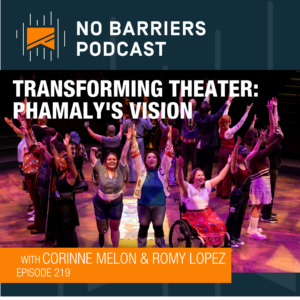
What happens when a group of disabled artists refuse to let tradition hold them back and instead flips the script, literally and figuratively? Can humor, adaptation, and radical inclusion create not just better art, but a more connected community? And how about this? Have you ever wondered what it's like to completely rethink how theater is made and who gets to be on stage? Erik sits down with Corinne Melon, managing director of Phamaly Theater Company, and Romy Lopez, one of their standout actors, to dive into these questions and more.
All right, let's get into it. You might never see the stage the same way again. I'm producer Didrik Johnck, and this is the No Barriers podcast.
Erik Weihenmayer: It's easy to talk about the successes, but what doesn't get talked about enough is the struggle. My name is Erik Weihenmayer. I've gotten the chance to ascend Mount Everest, to climb the tallest mountain in every continent, to kayak the Grand Canyon, and I happen to be blind. It's been a struggle to live what I call a No Barriers life, to define it, to push the parameters of what it means.
And part of the equation is diving into the learning process and trying to illuminate the universal elements that exist along the way. In that unexplored terrain between those dark places we find ourselves in and the summit exists a map. That map, that way forward, is what we call No Barriers
Hey, everyone. Welcome to the No Barriers podcast. This is Erik Weihenmayer, and I am psyched to talk to you guys today at Phamaly. C- Corinne, you are the managing director of Phamaly, and Romy, you're one of the actors in the production, in the theater company, right?
Romy Lopez: Yes
Erik Weihenmayer: it's really cool to have you guys on.
In fact, Romy, I was listening to your voice, earlier as we were prepping for this, and you have a very good voice. I could see... I can s- I can hear the audio of your voice. You have a excellent voice. Yeah. So I came to the Phamaly, Gala, the fundraiser, and man, you guys are outstanding. I just was so blown away and so excited to, to get to know you guys, quickly that night. and we'll talk about this 'cause I wanna come to, I think it's called 504.
Erik Weihenmayer: Yes. Yeah. I can't wait to come and listen to the play, so we'll talk about that at the end. But, Corinne, maybe start by telling me how things got started at Phamaly. Like, how did it get founded? I know there are five folks, I believe, with disabilities who were the founders. Maybe couldn't find opportunities elsewhere, and so they said, "Screw it, we're gonna create our own theater
Corinne Melon: yeah. Yeah, so we were founded in, 1989, by five wheelchair users who attended the Betchard School for Crippled Children, was what, literally what it was called then. and
Erik Weihenmayer: A word that's not used so much anymore
Corinne Melon: Yeah, not used so much anymore. they all went to high school together and did theater together in high school.
And then wanted to continue doing theater and perform professionally, but a lot of times they couldn't even get into the theaters to audition. So they decided to start their own company and apply for a grant, and were very shocked when they got their first grant, and were like, "Oh, crap, now we have to put on a show."
So they, tell the story, the five founders tell the story of sitting out on the 16th Street Mall in downtown Denver and just grabbing anyone that looked like they were disabled and being like, "Hey, you wanna be in a show?"
Erik Weihenmayer: That's awesome. And is that the reason for why you guys exist? Because, that attitude of like, "Hey, man, if I'm not gonna be accepted in the mainstream, of theater, then we're gonna start our own and celebrate what we have to bring to the table"?
Corinne Melon: Yeah. that's how we got started and we started out as kind of this, fun project that, five friends, created. It was originally titled the Physically Handicapped Amateur Musical Actors League with an w- a Y on the end. Now we're just Phamaly Theater Company, and we work with folks with any type of disability at any level of impact.
And we've gone from a kind of community organization to a professional theater that produces, four to six professional productions a year, sometimes around 45-plus performances. We work with 200, disabled theater artists a year and see around, 6,000 audience members.
Erik Weihenmayer: Amazing. A- and so you could have taken a tact, those five could have taken a tact th- where they say, "Look, we're gonna advocate to have more disha- disabled people in mainstream theater." But instead they started their own theater production, right? Their own theater company. Why did you go that direction rather than like, "Hey, we're just gonna advocate and push to get more disabled people into mainstream theater"?
Corinne Melon: I, I
Erik Weihenmayer: 'cause it seems like it turns out that it's a huge strength and advantage to have your own company. But at first I wonder if that was obvious, you know?
Corinne Melon: Well, I mean, back in when they were getting started, you couldn't even get a wheelchair onto a stage in a lot of theater spaces. And so they had to really fight a lot of, ableism, and there still is a ton of ableism in the performing arts. one of, one of our actors, Jenna Bainbridge, just became the first wheelchair user to play Nessarose in Wicked.
Erik Weihenmayer: I interviewed her on a podcast, probably a couple years ago.
Corinne Melon: Yeah, and so that character is a wheelchair user, but that theater had never been built for a wheelchair user to get on stage.
Erik Weihenmayer: And that, it's just so insane how theater and performing arts are still so ableist, and that's why PHAMALY needs to exist. And we, we work with a lot of theaters and businesses on how do you make your programming more accessible, and, try to spread that message throughout the world in performing arts especially, because it's just, there's still a very, a very low percentage of folks actually participating.
Corinne Melon: I think there's a, a recent study of something like 80% of disabled characters on TV are played by non-disabled people.
Erik Weihenmayer: Yeah. Yeah. That's amazing. so tell me how you came to Phamaly Theater, Corinne
Corinne Melon: Sure. So I, um, my background is actually in opera and music theater. and I was a performer for a while and I was really, experienced a lot of like, it's very difficult to be in the arts if you are not, uh, if you, if you have any sort of disability and if you, don't come from a wealthy family, if you don't have a lot of those things going for you, if you don't have a lot of connections.
And so I, started, initially started a opera company, called Denver Immersive Opera that was focused on supporting female identifying and LGBTQ artists. that company kind of went under during COVID because no one wanted singers to be around. And I managed an orchestra for a while, and then saw, this job opening at Phamaly and was like, "There's no way they would hire me."
Phamaly is legendary in the Denver Art Center, in the Denver art scene. They're so cool, they're so well known. Um, but I would love to work for them because they're one of the few organizations that really moves the needle in performing arts and is known worldwide. Um, and I applied and got the job.
And so it's been really amazing. I have, CPTSD, anxiety and depression, and, being able to work with a team that, will be like, "Okay, it's fine if you need a mental health day. It's fine if you, are having an anxiety attack and need to go home." You know, those sorts of things, it's, it's really amazing to work with a, a team that's so supportive and to be in part of this amazing community where everyone supports each other.
Erik Weihenmayer: Yeah. So you bring up something that's really interesting because there's obviously physical disability, and we learned about this at No Barriers very quickly in the beginning. Like, we were serving people with physical disabilities, but we realized there's a whole array of folks in the community that have these invisible barriers like anxiety, like trauma, PTSD, all kinds of stuff.
So do you guys work with folks with those invisible barriers as well?
Corinne Melon: Yeah, we work with folks with any sort of disability at any level of impact, and we're the, one of the only theaters that does that, one of the only professional theaters that does that. Typically in disability theater there's things like, um, Deaf West is one of the most famous ones in the US that only works with deaf actors, or Able Ensemble only works with actors with Down syndrome.
We work with everyone, which makes things more complex because
Erik Weihenmayer: Yeah, for
Corinne Melon: conflicting accessibility needs. But it's, uh, one of the things that's just so cool about our community is that, we can all lift each other up and support each other, and you see really cool things at Phamaly like a blind actor and a deaf actor working together to help each other get around backstage.
That's, things that you wouldn't see anywhere else
Erik Weihenmayer: And you guys are the longest running, theater production company as well, right? in terms of serving people with disabilities.
Corinne Melon: Yeah, we are the longest running in the US. We've been around for 37 years. we were founded one year before the ADA was passed.
Erik Weihenmayer: Yeah. Amazing. And how, how have you guys evolved since, I think your first production was Guys and Dolls? I, you weren't, I don't think you were there at that time, but you must have heard stories. Like, when you do something for the first time, it's crazy, right? It's just embracing absolute chaos.
Corinne Melon: Yeah, I've heard some, stories from the founders about that, those first couple shows. they were just trying to figure it out. I think,one of our board members, Mark Doucette, who's been with the company since the first show, he was brought in,I think two weeks before they opened Guys and Dolls because he was a professional actor and they were like,
Erik Weihenmayer: They had to bring in the heavy hitters
Corinne Melon: Yeah. and,we grew from, this community theater that was people doing it for fun, and we would do one show a year in the summer, to now, we're a professional theater. We're producing, four to six shows a year. We have programming, uh, additional programming that's just, for folks with cognitive disabilities to come and participate.
so we do a lot. and we had started as kind of only doing one big musical every year. Now, we do musicals and plays, world premieres, like we're doing this summer. We do everything. and we also offer free acting classes to anyone who identifies as disabled, through our partnership with the Denver Center, which is a great way to get involved and,dip your toe in the water if you're interested in starting acting.
And we also now have an internship program, for disabled youth interested in working behind the scenes, doing things like, um, grant writing or front of house or props design, sound design. And this year we've been able to, get funding where those folks are getting paid for the first time. So we have this amazing group of six young theater makers, uh, with disabilities that are working with us this summer as well.
Erik Weihenmayer: So what I'm hearing is that your life isn't very busy. You have a lot of free time. Yeah.
Corinne Melon: We're pretty busy all the time Phamaly. it stays pretty intense and pretty busy, but it's just amazing work,
Erik Weihenmayer: It is sounds
Corinne Melon: just such a wonderful community
Erik Weihenmayer: Romy, how about you? So tell me how you got into acting as a blind actor
Romy Lopez: So, uh, so about that. I have n- I... There are people in this company who were born for it, who studied it, who grew up in this sort of environment, and who went to school for it, and, you know, all this stuff. I'm not one of them.
Erik Weihenmayer: You're not one of those?
Romy Lopez: basically what happened was, my girlfriend, who has acted with Phamaly since the age of 14, she was in a production of Alice in Wonderland.
something that Phamaly had basically w- wro- like it was a very ambitious project, essentially from the ground up. the script, the, the music of the show was actually done by, Wheelchair Sports Camp, if you've ever heard of them.
the fr- the front, the frontman of that band, Cailin Heffernan, is a wheelchair user, and, they did the music for the show. But I- I'm totally tangenting here. anyways, so she did Alice in Wonderland, and I got to go to a couple of the cast parties where everyone yelled at me to please, please, please, please, for the love of God, audition.
Audition. There's this one person that was like, "I want to want... I want to costume you. I want to put you in things." And so it was o- as overwhelming as it was when the auditions for the Spitfire Grill came out, and basically I was asked the question, "Will you join?" My response was, uh, something along the lines of, "Eh, screw it.
Why not?" And so I threw my hat in the ring. My face turned green. I almost vomited all over the artistic director out of sheer stage fright,
Erik Weihenmayer: Nice. Yeah. Good.
Romy Lopez: and I made it in.
Erik Weihenmayer: Yeah. And
Romy Lopez: it in. I got called back. I made it in, and actually that was a touring show where we got to go to New York, which is funny because, like, the Tri-State Area is where I'm from, so for, for a lot of the cast it was a tour.
For me it was, "I get to go back home for a little bit." so that was fun.
Erik Weihenmayer: Now, as you, talked about the fear and of the anxiety, of course, which is all makes absolute sense, eventually you get more comfortable in this, s- scenario, and become a great actor. what do you love about it now? Like, what keeps you going and motivated?
Romy Lopez: I think it's several things that keep me motivated. Number one, I like knowing that I was a part of a whole. I like knowing that I helped in the creation of a story of a world, so to speak, and that I helped build that on stage. And I also love just all the sort of experiences that I have gotten to be a part of as a result of me just, sucking it up and just going for it.
I suffer from a lot of, generalized anxiety and social anxiety and stuff like that. And so I think being in this space kind of, don't wanna
Erik Weihenmayer: about confronting your fears
Romy Lopez: it very much makes me confront my own fears and sort of like get better at that whole, shebang. And I think what I love about it the most is just all the things that I've learned and, and something that I have also learned is, and, in the past I've only dealt in as far as like disability spaces go, I've only dealt with blind people.
And because
Erik Weihenmayer: dealing with a whole array, aren't you?
Romy Lopez: and because I'm dealing with a whole array, I feel like compared to my experiences before, I have gained such a broader understanding and my empathy has grown as a result. I feel like I was, like back then I basically was only getting one piece of the puzzle and it felt narrow.
it, it definitely felt like I was in a little box so to speak and getting to understand other disabilities sort of like allowed me to grow and expand and, even alter my mindset on some beliefs that I have held that are no longer the case and it's all because just honestly the level of empathy demonstrated by a lot of the people that I have gotten the privilege to work with is astounding and it's kinda made me wanna rise up
Erik Weihenmayer: that's really cool that you bring that up because what it tells me is that, like even though we're blind, right? Like it still doesn't immune you from like these,stereotypes and things like that you might have these presumptions about other disabilities,
Romy Lopez: It does not. And unfortunately
Erik Weihenmayer: camp just as easily as anyone else
Romy Lopez: And unfortunately, within these fact- the sections of the blind community that I've been in, there is definitely a lot of stagnation, a lot of, not backwards thinking, but yeah, screw it, backwards thinking. and I genuinely would love it if, like, the blind community at large were to sort of reach out their hands and clasp hands with, those in the wheelchair community, and hell, I feel like within the, you know, within, like, the autism or, like, the ADHD community, I feel like there is a lot of, quote-unquote, and Erik, you know this better than anybody, in this panel, but,we've all...
we've both grown up hearing about quote-unquote blindisms and things like that, and the amount of quote-unquote blindisms that I am now understanding to just be a symptom of autism or a symptom of ADHD is insane, and I feel like there is so much common ground that we could have. There is so much understanding and empathizing and just hand, and just holding hands, and we have the potential to do if only we were to reach our arms out to do it
Erik Weihenmayer: Yeah. At No Barriers, by the way, we really believe in this community approach of disability. Like we're all in this club together and we all can lean on each other and lift each other up. So that's a really, I think, powerful piece of your platform as well. I wanna talk about, like you'd mentioned, anxiety and stage fright. I'm a p- professional speaker so I speak in front of thousands and thousands of people and I can manage that. But I started pl- learning to play the guitar and, man when I play in front of literally like a group of 10 people my hands start to shake and my hands start to sweat and all this like bizarre stuff starts happening to my body.
so I imagine is that the natural case for a lot of people when they're starting out? Especially a person with a disability who maybe hasn't had the opportunities in the past to step out, right?
Romy Lopez: So I think for me, I can't speak for anybody else, but for me,there is a lot of, e- physiological symptoms that I definitely get. Obviously like the palms and everything. But I'm not gonna lie, it doesn't really go away for me. I just learn how to manage better. I have my own little sort of like ways to like prep before the show.
I, I meditate, I go like, if you, like, if you know martial arts, I do the, I do what's called a horse pose or a horse stance, which is basically you're pretending to sit on a chair that doesn't exist, and you hold it, and you hold it until you can't hold it anymore. And for whatever reason, that helps.
Don't ask me why it helps. It just helps.
Erik Weihenmayer: I'm gonna try it
Romy Lopez: Yeah. No, definitely. But it's kind of one of those ones, at least for me, it doesn't really go away. I just learn how to manage and just fight through it better
Didrik Johnck: Hey listeners, this summer has been going off with No Barriers events so far. Our team has loved connecting with so many of you. We've got one mega event to cap off the summer on September 12th at Winter Park Resort in Colorado. It's our annual What's Your Everest? And it's an all-abilities mountain adventure.
Start the morning with breakfast and connection, then head out together in small teams to hike three point nine miles to the summit at a pace that works for you. Adaptive equipment is available so everyone can take part in the journey. At the top, take in the views, then ride the gondola back down and celebrate with lunch, music, and community.
With more than two hundred participants of all ages and abilities, this is more than a hike. It's a chance to push your limits, connect with others, and be a part of something unforgettable. Head to nobarrierspodcast.com to learn more and register.
What are some other challenges... Oh, go ahead, Corinne.
Corinne Melon: Oh yeah, I was just gonna throw in there,as somebody that has, you know, always had anxiety, for me it's been always, you know, I don't perform anymore, but I got into performing really 'cause I could be someone else, and I didn't feel like I was that anxious person when I was being someone else.
And so I think that there is a little bit of freedom in that, of oh, I can, I am being another character who doesn't maybe feel what I feel right now. and that's very freeing
Erik Weihenmayer: Yeah. And I know you guys aren't therapy, but that sounds very therapeutic.
Corinne Melon: Yeah.
Erik Weihenmayer: Yeah. Yeah.
Romy Lopez: Oh, no, it definitely is
Erik Weihenmayer: I wanna hear about the other challenges as a blind actor. I mean, uh, like just knowing your space,your awareness of your space of where you are on stage and so forth.
I know maybe this sounds goofy, but like, as a blind guy, I'm always afraid that I'm gonna step off the stage. just the basic fear of that. Like, how do you manage where your body is on, on the stage?
Romy Lopez: So for me, the way that I've just managed to kinda w- j- cheat code my way through it is I have a very, very, and I mean very minuscule amount of vision. I can see shadows, I can see light, but what I do have is a crazy amount of spatial awareness.
And that is basically the only reason that I can survive. And, I can tell you right now, in the space that I'm working in, and I don't know why I know this, but I can tell you with absolute certainty that if you were in vom four and if you were running straight ahead, I can basically make it to vom two, provided there's nothing in my way, with my eyes closed, and I know that instinctually that I can...
If I were to just run straight ahead, I will hit vom two. I don't know why I know that. I just know that I know
Erik Weihenmayer: You just have good spatial
Romy Lopez: I just have good spatial awareness, and I think that, for me, is, like I said, that is the sort of cheat code that I have. And, sadly, a lot of my barriers really don't have to do as much to do with blindness at all as it is with the other stuff that I have going on.
I definitely have ADHD squirrel brain. I have never been formally diagnosed, but I fit the criteria. I can't sit still for more than five seconds. I need a fidget just to stay alive. And, my, in my early 20s, I had all the impulse control of a squirrel. So definitely ADHD.
Erik Weihenmayer: acting must help you with that
Romy Lopez: Acting helps me with the focus and concentration, but also it kinda hinders me in a way because I can just be in the wings waiting to go on, and this has happened a couple of times where I just transport myself to a magical land full of unicorns and rainbows and, "It's time to go on. Move." And that really has been my challenge.
And now blindness I feel like kind of enhances some of those sorts of things. Because like if you were sighted and if you put down your phone, you forget where it is because you have the object permanence of a three-year-old. You set down your phone, you can just look around, "Oh, there's my phone." But if you're blind, and if you have the object permanence of a three-year-old, now you just lost your phone for the next 20 sec- 20 years.
So m- in that, in, and so because I'm not getting as much visual stimuli, it is very easy for me to sort of tune out, and so I have to sort of like... What I'm learning to cope with it is like for example, like really listen hard to the band, really listen. Like even recite the lines. Like if, like if I know the lines of the actors that are going before me, I'll recite them in my head just so that I'm like in the game, so to speak,
Erik Weihenmayer: focusing
Romy Lopez: go out onto the field, or I mean in the stage in this case, like with the game face.
, And honestly, a lot of the barriers that I've had as a result of my blindness honestly have been set on by other people. And I have even been asked a couple of times when I've auditioned for other theater companies, "How much vision do you have?" And I didn't think about it at the time as to like the implications of that question, but then I thought about it in talking to other people about it, and it's like basically they were trying to ask me how difficult would I be to work with.
That's basically the question. Because if I was a high partial or if I had a lot of vision, oh, this person poses no challenges. But if I had no vision at all, oh brother,
Erik Weihenmayer: Ja.
Romy Lopez: here we go. So it's very much a feeling. I've definitely gotten a feeling of that in other companies that I've worked with. Not that every single company that I've worked with that wasn't Phamaly was like that, because I have definitely been welcomed with open arms in a couple of other places.
tying it back to your question earlier of, why, like why not just advocate for, for other, for mainstream theaters to hold space for disabled folks, I like to think that because Phamaly gets to showcase the talent, and you know, Phamaly has dipped into some- criminally underused talent pools.
And I think once, people see these shows, like the people, some of the people that are coming to these shows are directors in other theater companies, artistic directors in other theater companies that are coming to see these shows. And so they see us doing our stuff on stage, and that I like to think, I have no proof, I have no r- I don't have the spreadsheet in front of me to prove this, but I like to think that because they see us on stage and because they see us perform well on stage, it sort of opens their minds and their hearts to the idea of "You know what? maybe it wouldn't be so bad. Maybe it wouldn't be so bad." And I like to think that is the case. And,
Erik Weihenmayer: that.
Romy Lopez: and often, and oftentimes, like people, and even Adam had said it, like in a perfect world, Phamaly would not exist, but unfortunately we don't live in a perfect world.
Erik Weihenmayer: In the mainstream, Corinne, you, had mentioned that, a lot of people with disabilities, there's just, like, doom and gloom around them. They're- you're supposed to pity them. and, you know, s- but ... And you guys celebrate, right? You celebrate the f- fact that people have different abilities and so forth.
so what myths do you wanna bust through as part of that process?
Corinne Melon: Um, I think, you know, especially in theater you see a lot of times the ... If you see a disabled cha- character, they're someone to be pitied or they're the villain. that's kind of the stereotype. And, and that's what's so amazing at Phamaly is that every single character is played by a disabled actor.
And so, you know, when you do see ... That is the problem with the, like, why not we, why don't we just get mainstream theaters to be more accepting? they'll be like, "Let's put one disabled person in one show for the whole season," and it's Glass Menagerie where you have to feel so sad for this poor little disabled girl.
Whereas, at Phamaly it's the romantic leads, it's the hero, it's everyone. And, we really try to stage our shows where, your disability can help tell the story in some way. Like we just did Little Women earlier this year, and we cast a deaf actor as Meg, the oldest sister. And in that story Meg has to, falls in love with, the neighbor's teacher.
Erik Weihenmayer: And w- the way we staged it, we had the love interest, John, learn more ASL as they got to know each other. And by the time they get together he's fluent in ASL. And that is, such a deeper love story than just they fell in love with the neighbor, And, isn't that... So you're cha- so you're, you sometimes I've heard this, you change the script just a little bit. You can tweak the script, right? to make it fit a little bit better?
Corinne Melon: it depends. That show we were actually working with the playwright. It was a regional premiere,
Erik Weihenmayer: I heard that, yeah.
Corinne Melon: Sometimes we're not changing the script at all. we will just, do it as performed, and it actually can create some really interesting, fun moments. Like, uh, Romy was in Spring Awakening that we did a few years ago, and there was a line, it was actually his girlfriend had, Sam had to the character playing her mom, to the person playing her mom, "Can I put y- my head at your feet, and you tell me about this?"
And the actor that was playing the mother had no feet. And so she just lifts up her skirt, and she's like, "Where? I don't have any feet for you to put your head at." and so sometimes we leave things in there that are, can be, like, either amazing jokes or can actually,show how ableist a script is.
another show that Romy was in with us, 25th Annual Putnam County Spelling Bee, has the R-word in the script, and we had someone with CP use that word in the script. And so it really kinda can show you, like,
Erik Weihenmayer: Huh
Corinne Melon: it can either be something that can become a really poignant moment, it can become a humorous moment, but sometimes we leave things in scripts that are ableist just to
Romy Lopez: to sprint like a madman across the stage in that one
Erik Weihenmayer: Yeah. I think that's so cool. like especially the idea, well, you create these really interesting dynamics between people and between different kinds of disabilities. But I also love the idea of humor because obviously when I'm climbing a mountain with my friends, there's a lot of humor. We're busting on each other and having so much fun, and there's some blind jokes and, I know like there are organizations like the National Federation of the Blind that talk about humor within disability.
Like, you know, you don't want,s- humor that insults people with disability, right? Like you want it to be an inclusive kind of humor. But I've always thought humor is just such a great icebreaker, and so it sounds like you guys don't shy away from those fun moments too, right?
Corinne Melon: Oh yeah. humor is one of our values. And Romy, do you wanna tell about, Spelling Bee, the blind jokes and Spelling Bee?
Erik Weihenmayer: Yeah.
Romy Lopez: Oh my God. s- so s- oh my
Erik Weihenmayer: Yeah, give me a couple of the blind jokes that you
guys
Romy Lopez: and you're making me remember him 'cause I actually saw him yesterday. so the person who played, one of the characters, he is the vi- vice principal, Pan- Panch. his, the actor who plays him, has one arm. And so there is...
And so basically, they're doing a spelling bee and, it's oh, this per- this person comes up. Well, this person is, this person or whatever. and so one of the, one of the ones that he had made, and this was at both my girlfriend's and my expense, it was like, "In poker, the big blind is twice the size of the small blind, which is exactly like the two blind me- cast members in our cast."
Erik Weihenmayer: Nice,
Romy Lopez: But of course I had to, of course I had to get him, get my revenge. And so I re- started to refer to him as Stumpy. and one, and, and, um, basically in the scene where I am running across the stage because he is, he's getting all worked up and I'm getting mad at his be- o- on the behalf, on behalf of the kids because he's real- he, like, his character is being super mean to one of the kids.
I'm sprinting across the s- stage screaming, "That's it, Frodo, I'm coming for you."
Erik Weihenmayer: So there's a little bit of improv going on
Romy Lopez: Yeah, so it's a good time. And yeah, so I think, the idea is, and, though I get kind of some of the NFB's feelings about this because, sometimes it is kind of punching down, especially like if you don't have a disability. We all have disabilities in this space. Every single one of us has something going on.
So it's not, it's not like the big guy picking on the little guy. It is literally just a bunch of us commiserating. yeah. like my, m- all of our f- all of our friends basically refer to this as the blinds house, B-L-I-N-D-S house. And, and sometimes I like to mess with our, my, our...
I almost said autistic director, but our artistic director is in fact autistic. And sometimes what I like to do is when he's, is especially if he's, like, making a joke at my expense, is to adopt the greatest poker face of all time, and just blank, no expression at all. Just impossible for him to read me.
Erik Weihenmayer: Nice. So you guys are giving each other a
Romy Lopez: we're all giving each other a hard time, and I think, like, it, it, as you said, humor erodes those barriers because now we're getting comfortable around each other and, And within the spirit of community, of course,obviously for me at least if, if I go overboard obv- obviously I wanna know about it.
But, within the spirit of community and friendship and camaraderie, we definitely, just have those moments. I have heard legends of way before my time in the ti- in, in back when, Phamaly was young, of legendary wheelchair races, sometimes involving people who may or may not necessarily use wheelchairs. And that is just a thing that happens apparently. so you know, it's great to hear about those moments and those stories. I think it's beautiful.
Didrik Johnck: No Barriers would like to recognize and thank CoBank for their support of No Barriers. Since 2016, CoBank has provided access to our life-changing programs for veterans and family caregivers from rural communities. CoBank is one of the largest private providers of credit to the US rural economy. The bank delivers loans, leases, and other financial services to agribusiness, rural infrastructure, and farm credit customers in all 50 states.
If you live in a rural community or work in agribusiness, we want you to know that CoBank supports this kind of holistic support for your community
Corinne Melon: Yeah. One of
Erik Weihenmayer: I think... go
Corinne Melon: Oh, I was just gonna say another hilarious story, from the olden days of Phamaly is there's a blind actor who has a glass eye who liked to use his glass eye to play pranks on people,
Erik Weihenmayer: Ah, ja
Corinne Melon: losing his glass eye.
Romy Lopez: on you
Erik Weihenmayer: Yeah, I have prosthetic eyes too, and I tell people I'm the, I, you want me to bet you that I can bite my eyeball? And they're like, "What? You can't bite your eyeball." And you take it out and bite your eyeball. It's great. It's a fun bar trick. Um, so behind the scenes must be kinda crazy and fun and chaotic as well.
Like, I can't, I just am picturing this, trying to choreograph, like, a dance scene with folks who are deaf and blind and people in wheelchairs and different abilities. Like, how does someone learn to do that? Because there's ... it's gotta be a lot of trial and error. There's gotta be a lot of just, like, creativity in terms of, like, putting people together and then making it look right and fun, right?
Corinne Melon: Yeah, part of the way we make everything work is we have a, a full-time physician at Phamaly called the production accessibility manager, and his whole job is making sure access needs are met, and that especially is in rehearsal. And so he is always, in every rehearsal, making sure all the actors have what they need to learn their lines, to learn their blocking.
and then on shows that are large, like the f- the show we have coming up this summer, he's got an assistant. and then we also will have not just one choreographer, we'll have a choreographer and a choreography assistant so that there is someone who can go out and,physically help blind folks with choreography or, be a second set of hands to go around and help people with things.
So we... There's a lot of trial and error, and we're always learning new things, and we're always figuring out new ways of doing things. but I know, like, back, one of the, the, the original things that, they figured out with blocking is, hey, if you have somebody who is blind who doesn't know where to go on stage, and you have a wheelchair user who needs to get across stage really, really quickly, have the blind person push the wheelchair user.
They can get across stage really easily, and the, the wheelchair user can guide them as to where to go. And there's little hacks like that we, use all the time at Phamaly
Erik Weihenmayer: and you bring up an interesting thought that, maybe it's obvious to you all, but maybe not so obvious to others, is that all disa- disabled people aren't born equally. they have different talents that go past their disability. So somebody might be a great singer, somebody might be a great dancer, right?
So you're still, looking at people's ability and trying to fit them into the right places, right?
Corinne Melon: Oh yeah, and one of, one of our best dancers is deaf, which you would not expect, but one of... Lily, one of our very best dancers in our company is deaf. And we're looking at, at what people are really, where they really shine, and not thinking about how does the disability affect that, just how do we make them shine the brightest and give them the opportunity to do what they need.
And so one of the things we work with sometimes is a vibrating dance floor panel, that, Feel The Beat has developed that vibrates at every frequency so you can literally feel the beat, in rehearsals. We have all, all sorts of things that we're using. and, you know, we also are designing all of our tech around, folks' access needs.
We don't believe in sensory-friendly at Phamaly. We don't believe in doing, like, a lesser show for people with disabilities, so we are always taking into account seizure risk in our lighting design. We're taking all those things into account so that we just do a relaxed performance where audience members can maybe get up and move around.
But there's no possibility of, we don't want you to feel afraid to come to a show, and we don't want to have to damper the show for someone with a, a disability
Erik Weihenmayer: I love it. And Romy, like, so when you're in like say, like say you're in a dance scene or something. I, my one limited experience was, a couple plays in camp where I was in Pirates of Penzance, and I was always afraid that I was gonna be out of sequence. You know what I mean? I was gonna... Like, I'll be doing the twist while everyone else is, i- is doing some other dance, you know?
And l- like, it was always my fear, like when I... 'Cause I was one of the cops in Pirates, and so you're supposed to be doing, you're supposed to be all choreographed and doing the same thing, and I was always like nervous. am, I can't see the other folks. am I like a step behind? so that, I just wonder if that's a little bit of a, something you have, y- you have to work through.
Romy Lopez: It always is. And the truth is, there's really not much I can do about it. Because the thing that I kinda realized is, A, it obviously is gonna take me a little bit longer to get the choreo down because I have to learn it in a different way, and B, even if I learn it 100% down pat, get the moves perfectly correct, which I like to think that I, once or twice manage to somehow pull out of my ass.
Even if that, all of that happens, the guy next to me might not. The guy on the other side of me might not. So now, based on just those three people, you're looking at those three people, and it looks like they're doing it right and I'm doing it wrong. And I know that, and I understand that. It's still...
There's real- and again, there's not really much that can be done about it, because I can't see what they're doing, so I can't really go by what they're doing. So I basically just do it the way that I was instructed and hope for the best.
Erik Weihenmayer: Yeah,
Romy Lopez: and unfortunately, that's kinda like, at, at some point, you know, that is what, I found out that is the case.
And it's just, it's, it hasn't really been as big of a barrier as you would even expect because, mo- you know, most of all because, you know, most of the people, in the pe- in the cl- in the projects that I've worked with, are on their game, and they are, like, getting the choreo down.
So
Erik Weihenmayer: We gotta trust that they're doing the
Romy Lopez: you have to
Erik Weihenmayer: doing the right thing.
Romy Lopez: that they're doing the right thing, essentially. And they, and more often than not, they do. So it's not really, like, that, a big barrier, so to speak, in that instance. it's just, for me and especially, learning the choreography, I have to sort of, like, either, either have the movements described to me verbally or if I can, get within, close personal, I'm talking, in your social bubble for me to actually, like, look or, like, feel your arms or your legs.
And I can learn it. And once I have it. It's just about learning
have to learn probably kinesthetically. that's the way I had to learn how to ski and stuff. You know, just by feeling it feels right Yep, and that's the
Erik Weihenmayer: you lock into that right feeling
Romy Lopez: I have the advantage of being a very kinesthetic learner. I mean, it certainly helped in martial arts. But I have that advantage of being an extremely kinesthetic learner, and so it does help, and I definitely rely on that for choreography practice
Erik Weihenmayer: Yeah. Corinne, I like the stories of, of adaptation, like you talked about the blind person maybe pushing a person in a chair across the stage. Are there other examples of, cool adaptations that you guys might make? Like little tricks of the trade that you've learned over the years
Corinne Melon: Oh, I mean, there's, there's so many. I know, some of our blind actors like having a tactile tape put on, like say a railing to find your spot. or, having, something, tactile that you can put on the floor, again, to find your spot can be a thing. we
Romy Lopez: Oh yeah
Corinne Melon: What were you gonna say, Romy?
Romy Lopez: Oh no, it just said, "Oh yeah."
Corinne Melon: Yeah, that's a, a thing that a lot of our blind folks have used. Or I know, Linda Wirth, who has been with us for, like, over 20 years, she's the queen of counting steps. She counts, all of her steps across the stage and she knows exactly how many steps she needs to go to each, bit of blocking.
Um, but it's always, you know, adapting for each person and what works for them. there are things that we do, like we will keep, um, ice packs kinda stashed on stage for folks that maybe have a seizure disorder and getting too hot might throw them into a seizure. we will do things like, little, rolly stools are sometimes, really great for us to add into a set design in case someone needs to sit down suddenly.
Um, just little things like that. as well as, some, more fun tricks that we have done, here and there,that can either be funny or part of the blocking. I know there was, there have been jokes about how many times we've ended up using the lights on one of our actor's wheelchairs, as something in a show.
so we have a, an, an actor who has, like, headlights on his chair,
Erik Weihenmayer: Ah, nice
Corinne Melon: them for lighting, we've used them for comedic effect. and it's just a, a fun little thing that, you can add in there. Uh, um, we've used it when he's been mad at someone. He has, raised up his chair and turned on his headlights, which is, a, a great way to intimidate someone on stage.
Um, so there's always, we're always finding new little fun things like that.
Erik Weihenmayer: And Corinne, tell me a little bit more about how you figure out the roles for people. I think there was Miss Holmes, Mrs. Holmes, and,there's some ideas that Sherlock Holmes had, autism, uh, was on the spectrum in some way, and so you had an autistic, actor, actress playing that role.
So you kinda like sometimes slot people in to kind of fit the character maybe, but maybe sometimes you don't, right?
Corinne Melon: Yeah, it really, our, artistic director, Ben Raanan, is really amazing at casting and actually worked in casting for many years, before he became an artistic director. And so a lot of times it's,fitting someone in, a part where it really makes sense, for that character ha- to have that disability.
So like you were saying, we did Miss Holmes, which is a female retelling of Miss, of Sherlock Holmes, and as we were starting to cast, we realized, Sherlock Holmes probably was autistic. That's a very autistic character. And we cast an actor with autism and really leaned into that.
And it made the, the character so much more interesting. Um, And so there are a lot of times where we'll do things like that. when we did Midsummer Night's Dream, we really felt it was, more interesting to have the lovers all portrayed by folks,mainly folks with, physical disabilities, because the lovers in most Shakespeare plays are, like, gorgeous and perfect and all of those things.
And so turning that narrative on its head of, yeah, you can be beautiful no matter what your disability is. and you can be the romantic lead. so there are, are things that, we do like that all the time of being like, "How can we make it, more interesting?" there was just a really silly thing in, Spelling Bee that Romy was in where there's a character, Olive, who has to say, "I saved a chair for my dad in the front row."
And, as soon as we started talking about doing that show, Ben was like, I would love to cast a blind actor in that because then she doesn't know where the front row is, and it would be hilarious." And so we have her, you know, go and say, "I saved a chair for my dad on the front row on the aisle," and she points into the audience and it's not where the chair is that she saved, and someone has to move her arm to where she's supposed to be pointing.
just it can be silly things . Uh, it can be, things that, socially say something, or it can be things that it's oh yeah, that character probably did have this disability.
Erik Weihenmayer: But then you can go the opposite way too, right? Like, you could have folks dancing in wheelchairs, and it's like the, it's nothing about their wheelchair. It's just the way they dance, right? So it has nothing to do with their disability. So you gotta go both, both, both directions
Corinne Melon: Yeah, when we did Chorus Line, we cast an actor, there's a tap, very famous tap number in Chorus Line, called I Can Do That, in the opening, like, for, towards the very beginning of the show. And we cast a wheelchair user as that role. And, you know, typically you would think a wheelchair user can't tap.
but we created tap gloves for Casey, where he had little taps sewn into his gloves so that he could tap on his chair itself, and it still made the sound of tap dance. so we're always looking for how can we turn things on their head?
Erik Weihenmayer: Explain to me, this idea, and I think you've done it already in a dozen ways, but radical inclusion. I love that phrase, and that's one of the foundations behind Phamaly
Corinne Melon: Yeah. that is, accepting everybody with any type of disability from any background that's a member of any group, and loving them wholeheartedly. we really... Our, our staff spends a lot of time thinking about how does, disability, how is disability viewed in different cultures and different communities?
What does your disability mean if you're a part of other groups? Because, we are all intersectional, we're all part of multiple groups. Your disability doesn't exist in a monolith by itself. And it can be viewed differently dependent on, where you grew up, what you grew up with. are you LGBTQIA?
Are you trans? How does that affect your disability and how you view your disability and how you, perceive yourself in the world? and that is a, a big part of what we do at Phamaly is we're not just saying we're inclusive for folks with disabilities. We're inclusive no matter what community you're a part of.
and we're really proud that we have been seen as, a safe space for the trans and non-binary community. a lot of our shows, I know Chorus Line, which we did year before last, like 40% of that cast was trans or non-binary. In a, a time when that community feels really threatened, we're really, happy to be a safe space, and to always be considering, like, what do those things mean for folks?
one of the things that is a, has been a, a conversation in our staff is how do you, when you have a community that has all these different disabilities, how do you explain, pronouns to someone with a cognitive disability? And how do we make sure everyone feels safe and included and, that everybody can work together a- and feel, safe and loved?
And so those are things we're always talking about. our staff does a quarterly DEIA book club where we have someone come in from, a different underserved community and talk to us about issues in that particular community and how does that relate to disability. So we're always looking to grow and, figure out ways to do things better and make sure that we're more inclusive and,meeting everyone where they are.
Erik Weihenmayer: And I love the fact that you guys... I'm so impressed by the fact that you guys are proud and bold about inclusivity. and, a- and you have, and you've held your ground with that because it's so important, even though weirdly it's become this like dirty word or something in our administration. I know you guys lost a little bit of funding, so everyone who's listening to this should go out and donate to Phamaly to up for that shortfall because that's...
I'm really proud of you guys. That's really cool. tell me about 504. Romy, are you in 504?
Romy Lopez: Yes.
Erik Weihenmayer: Cool. So yeah, tell me about this... Nice. Tell me about it
Romy Lopez: Uh, what do you wanna know?
Erik Weihenmayer: tell me what the play's about. A lot of people don't know about the disability movement in the '70s. I think it started with a sit-in
Romy Lopez: Yeah, it did. so basically the play, essentially like is a fictionalized retelling of that sit-in. they, There were people, in fact, in, I believe, was it the San Francisco government office that actually did sit in for over two weeks on end, because Section 504 was not passed.
And, essentially it is from the, point of view of a couple of protagonists, June and Bruce, who I consider to be like the, the s- the shield and sword of the movement. And then we have E- Eve, my fellow, blind actor, Juliet, who plays the part of Florence, who I feel like is if June is the shield and Bruce is the spear, she would be the flag.
She would be the standard, the banner,the thing, the rallying point. Because she at first is very reluctant. is kind of like, "You know, y'all aren't doing anything. All you guys are doing is just screaming into the void," and yada, yada, yada. But at the end, she, her character undergoes this remarkable transformation and you kind of like sort of through a couple of her songs and just through the dialogue itself, you get to understand her, her inner workings, and she genuinely doesn't feel good about herself at the beginning.
She doesn't think she's beautiful. She doesn't think she's any and all that. But then at the end she's like, "You know what? Maybe I am. Like, maybe I am beautiful. Maybe I am worth something. Maybe I do deserve to be in," uh, she tries, she's trying to get into this art class, and maybe at the, and at the end she's like, "I deserve to be in this damn art class."
You know? And she gains a lot more confidence and a lot more like strength and belief in herself at the end, and that's kindthe whole point of the entire movement, is just, to not allow the, like the system, society, whatever you wanna call it, to sort of turn you into anything less than who you were meant to be.
And because she, the, her character was institutionalized, because her character was brought up under these very oppressive systems, she was afraid to step outside of it. You know, I, I'm likening it to the baby elephant metaphor, if you've ever heard of it, where basically like circus masters, they chain a baby elephant- to a tree with really strong chains, but as the years go by, the chains get weaker and weaker.
And at, a- and at some point, the elephant becomes big and strong and powerful. But because he has been conditioned from the years that he was a calf, that he was too weak to break free of the chain that bound him to that tree, he just internalized that belief and basically is tied to the tree with, like, a piece of string practically.
And that's, he doesn't know any better. He doesn't know any different because he's been belie- he's been conditioned to believe that he couldn't break free from that chain. And I think Florence is the best example of that sort of baby elephant, idea. The idea that, she was held back throughout all of her life.
She was in this, institution. And now Bruce is the spear, June is the shield, and, us, us in the ensemble we're kind of like the army, so to speak. And like I said, yeah,
Erik Weihenmayer: you guys are breaking through that, you're breaking through that chain as a whole theater.
Romy Lopez: As a whole theater. That's literally the whole point
Corinne Melon: I wanted to throw in there, so we were brought this musical a few years ago. Um, it'd been in workshops for a while. And, last year when, 504, when the lawsuit started against 504, we felt it was really important to bring this to the stage. because, for folks that don't know, 504 was the first legislation that gave folks with disabilities civil rights.
And, there are, at one point, there were 17 states suing to get rid of that legislation. now it's down to only three states are still on that lawsuit. but it's still in the courts. And so we felt as, a community it was really important to bring that to light and bring the protestors' story to light.
So the protestors at the San Francisco Federal Building sat in for 25 days, and occupied that building. And eventually moved to, went to DC and were able to get the 504 legislation signed and put into effect, which,required any organization or business receiving federal funding to provide accommodations for people with disabilities.
So the way that most people hear about that is, 504s in school. a lot of people know that. or, like, curb cutouts, or, access on buses, which we know about in Denver from our,our gang of 19 that, did protests, just a few years later,for making sure that buses were accessible. So we felt it was a really important story to tell at this particular time. Um, so this workshop, this show's been in workshops for several years. It was written by, Abby Goldberg and Mason McDowell, who are both,writers with disabilities. And, we're just so excited to bring it to the Denver Center.
the biggest theater complex in the
Erik Weihenmayer: and I'm gonna come. When it... Is it starting now?
Corinne Melon: So it opens, we run... It opens on August 8th. There are previews on August 6th and 7th, and it runs through August 23rd. there are... You can get tickets, yeah, here in Denver, you can get tickets on our website at Phamaly.org, and that's spelled P-H-A-M-A-L-Y dot org.
And we're really passionate about making sure that, tickets are accessible to everyone, so we offer, $5 inclusive hospitality tickets at the door, as well as 50% off rush tickets at the door. So we wanna make sure everyone gets to experience this. We have several access performances scheduled, which is where we provide all of our access services, including ASL interpretation and audio description.
But if you need, one of those services on a different day, just email us and, we'll make that happen for you. Um, so email us at info@Phamaly.org. we try to ask that you give us two weeks notice for those, additional dates that are not already on the website. Um, but we can tend to make that happen, especially audio description.
All of our staff is certified in audio description, so we can, make that happen for you. We want everyone to be able to experience this, amazing story
Erik Weihenmayer: I love it. so my last question, 'cause I don't wanna keep you guys all day, my very last question is, obviously you guys are putting out amazing work, right? Really entertaining, beautiful plays. but there's a... there's stuff that goes beyond specifically acting and performing, right? There's leadership, there's social connections, there's community, there's education, there's awareness, right?
so there's a deeper mission behind, this project, right?
Corinne Melon: Yeah, we're always, we're trying to provide opportunities for people with disabilities, but also to change hearts and minds,and let people know that we can do anything and we can, create a really amazing art, and that your theater is only going to be better if you include people with disabilities.
and to change people's perspectives. I had an audience member write, a feedback one time that said, "I feel like after watching one of your shows, I'm a better and more kind person." And that's what we're going for. We want people to change their minds, change their perspectives and think about, "Oh, maybe I can include everyone," because it, everything's so much better when you do
Erik Weihenmayer: And Romy, yeah, tell me what you've learned along the way. How have you evolved as an actor being a part of Phamaly?
Romy Lopez: I definitely feel very much the spirit of community, and especially, the story that 504 tells is not just some relic from the past. The hyenas are in the Pride Lands now. The, like the wildlings are in Westeros. we are here again. there are institutions that are actually trying to throw au- autistic people in frickin- in- institutionalize them.
There are people that are literally talking about that, and we are just in, in it's here. The, the struggle is happening again, and I think now more important than ever, I think not just this show, but just like every experience that I've had in Phamaly as a result, is teaching me that now more than ever, community is not only important and necessary to like our growth as individuals and like our empathy, but it's...
But it might be honestly essential to our very survival
Erik Weihenmayer: I love that. That's, let's end there. That's perfect. Wow. I'm so excited. I can't wait to come, and I guess it, it's always weird when blind people say see the play, but you know what I mean. I wanna come see it and,and celebrate with you guys. So thank you for joining me for the last hour. Corinne and Romy, thank you so much, and No Barriers to everyone
Corinne Melon: Thanks for having us
Romy Lopez: Thanks for having us
Didrik Johnck: The production team behind this podcast includes producer Didrik Johnck, that's me, and audio engineer Tyler Kottman. Special thanks to the Dan Ryan Band for our intro song, Guidance. And thanks to all of you for listening. If you enjoyed this show, please subscribe, share it, and hey, we'd be thrilled for a review.
Show notes can be found nobarrierspodcast.com. There's also a link there to shoot me an email with any suggestions or guest ideas for the show. Thanks so much, and have a great day