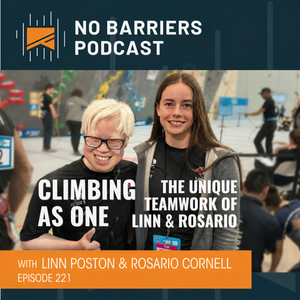
Episode 221: Linn & Rosario Interview
Didrik Johnck: Welcome, welcome to the No Barriers podcast hosted by Erik Weihenmayer. He's about to jump in here, but first, let me tee up this episode. You'll meet a pair of teenage athletes, Linn and Rosario. They're a team navigating the pressures of elite competition in the sport of indoor paraclimbing. Linn climbs blind, sometimes fast and dynamic and sometimes slow and precise.
Rosario acts as Linn's eyes, calling out each move with vocal instructions designed to guide Linn up the wall in real time. Whether you're a climber or just curious about how the strongest partnerships are forged under immense pressure, this conversation promises a behind-the-scenes look at elite adaptive sports, the science of communication, and the relentless will to break the mold.
All right, let's do this. I'm producer Didrik Johnck, and this is the No Barriers podcast.
Erik Weihenmayer: It's easy to talk about the successes, but what doesn't get talked about enough is the struggle. My name is Erik Weihenmayer. I've gotten the chance to ascend Mount Everest, to climb the tallest mountain in every continent, to kayak the Grand Canyon, and I happen to be blind. It's been a struggle to live what I call a No Barriers life, to define it, to push the parameters of what it means.
And part of the equation is diving into the learning process and trying to illuminate the universal elements that exist along the way. In that unexplored terrain between those dark places we find ourselves in and the summit exists a map. That map, that way forward, is what we call No Barriers
Erik: Hold off one second, 'cause I have a cat that is in here meowing. Get out of here, cat.
Hey everyone, this is Erik Weihenmayer. Welcome to the No Barriers podcast. wow, we got two world champions. I'm getting to interview two world champions, Linn and Rosario. Good morning. How are you guys doing? I hear you're at Inglewood Climbing Gym, and I've interrupted your training, which is kinda cool.
Linn Poston: Yeah, I'm really looking forward to talking to you. Uh, it's awesome. I'm really excited to share our story with this.
Rosario: Yeah, this will be a great opportunity. Thank you so much for having us.
Erik: Oh, yeah. It's gonna be fun. And so, uh, so you guys are off to college very soon, so thanks for squeezing me in as well. we're doing this in kinda mid-August, and when do you guys leave for college, and where are you headed?
Linn Poston: Uh, so I'm heading to CU Boulder, and I'm leaving this Tuesday
Rosario: Yeah, I'm also leaving Tuesday, which is crazy, and I'm also, um ... Oh, I'm going to CSU up in Fort Collins
Erik: Uh, so you guys will be like an hour apart.
Linn Poston: Mm-hmm
Erik: to climb together a little bit still?
Linn Poston: Hopefully, yeah Yeah. We'll see. We could definitely drive up to the mountains or something. Yep
Erik: Yeah. And Linn, are you excited, like going up to see you? You got a dorm? Are you gonna live in a dorm?
Linn Poston: Yep, I'm living in Smith Hall. Pretty excited for that, so yep
Erik: Uh-huh. And then what about you, Rosario?
Rosario: Yeah, same. I'm living in a dorm
Erik: My daughter Emma goes to CSU. She's still working her way through the program.
Rosario: Oh yeah, that's awesome
Linn Poston: Nice.
Rosario: Maybe I'll meet her.
Erik: you guys are gonna have
Linn Poston: Yeah. Yep.
Erik: get more to, um, your, what you're gonna study and stuff later. But, uh, so I wanna focus a little bit, um, on your world championships.
I think in... Was it in Korea? Was it in Seoul, Korea?
Linn Poston: Yep, Seoul, South Korea
Erik: Yeah. So that's exciting. And I listened to a video of y- of you all talking on an interview, and, uh, you know what's funny is that even though that w- how long ago was that?
Linn Poston: Oh, it was last, like, late September
Erik: Yeah,
Rosario: Mm-hmm
Erik: sound so much more mature and older now. Your voices sounded so young, even though it was just a year ago.
Linn Poston: Funny. Yep. Yep. Time flies. Yeah
Erik: I know, it is. It's, especially at your age, like a s- like six months is like a lifetime, you
Linn Poston: Yeah, really.
Rosario: Mm-hmm.
Linn Poston: Yep
Erik: so talk us through, uh, Worlds, like, 'cause I think for our audience, they don't understand really what a world championship rock climbing contest looks like. They have idea, especially for, uh, people who are blind and visually impaired, right?
So, so Rosario, Rosario, you're Linn's caller, and so you guys work as a team. You fly over to Korea. Yeah, tell us how, like, the day goes.
Linn Poston: Okay. Uh, so I guess just, like, to start with the basics, um, there, so there's two days. You have the qualies and finals day, and on the qualies day there's two climbs, and I believe it's, like, what do they call it? Like, flash format or something.
Rosario: Mm-hmm.
Erik: Yeah
Rosario: we can see people climb- Where...
Linn Poston: Yeah ...
Rosario: there's an order.
Linn Poston: Yep, so you can see people climb, but there is an order to it, and you just get one attempt at, uh, each climb. There's two climbs, and then you, from there it determines placing for finals, for the running order for finals, and who moves to finals. So for that one, I believe it was, like, the top four, yeah, the top four climbers, uh, in my category moves to finals.
And then on the finals day it's just one climb, one attempt, and whoever gets higher, uh, wins. Mm-hmm. That's all you get is one attempt? Yep
Erik: You don't get like three tries or
Linn Poston: No. They used to do that at, like, the nationals and stuff, but then, like, it would kind of ... They wanted to simulate more what it would be like when, like, on the world level and then the world level is trying to simulate what it's gonna be like in the Olympics and Paralympics
Erik: So with blind climbing though, they don't want you to get an idea of what the wall looks like, so they keep you in, like, this little private enclosed room, right? Tell me about that, 'cause that's really interesting to me
Linn Poston: Mm-hmm.
Rosario: Yeah. So basically we're kind of isolated in like an warm-up area for a while, for like two hours before we- Mm-hmm ... get to go out and try the climb. Um, and there's this preview section where we, the callers and the climbers walk out, and then we have like, is it like five minutes? Six minutes. Six minutes to look at the route and just kind of plan out what we are gonna do when we go and climb it.
And we go back and we kind of focus our warm-up based off of what the climb kind of looks like or what hard moves we anticipate there being
Erik: So Rosario, that means like you as the eyeballs have to like go in there and assess that route and glean a ton of information that you're conveying to Linn at that moment. That's not, that's a lot of, of pressure for a little amount of time, right?
Rosario: Yeah, yeah. Honestly, my goal for that is just to, like, look at the route and then just kind of walk ha- walk Linn's hands through a hard sequence that we find, and then just kind of regroup once we get back into the warming area.
Linn Poston: Yeah. And then also, also in the warm-up area, there is a picture, uh, of the climb.
It's not a great picture or anything, but it's good enough that you can kind of like, you can look at it to jog your memory of what the a- what the actual climb was
Erik: And Rosaria in the world, in the, in the last, uh, you know, finals, did... heard there was like a crux move where, Linn, you had to like traverse and there was kind of a bouldering problem. That's kinda techy language for non-climbers, but a, a tricky kinda m- section of movements. And so did you spot that right away and go, "Oh God, that's gonna be the crux"?
Rosario: Um, I think specifically for that one, yes, right? Mm-hmm. Yeah. Yeah, and then I think the main thing that happened that time actually was, like, we had, like, two plans, like an option B in case option A didn't work out for, like, t- sequencing that section. Mm-hmm. So we're kind of, like, conversing in that moment.
Like, I'm asking Linn if s- like, section A kind of feels like kind of secure enough to continue or to change that sequence. Yeah,
Linn Poston: or to go to plan B-
Rosario: Yeah ...
Linn Poston: and do a different thing
Erik: all this theoretically, like, right? 'Cause she's not touching the wall. She can't g- like, climb up 30 feet and feel the thing, so you're just... This is all verbal, right?
Rosario: Yeah, this is all verbal
Linn Poston: Yeah. We make the plan, plan A, plan B, and then once we're on the wall, once we're like actually on the wall a lot later, then we can like for sure decide which one we're doing. But we have both ready
Erik: So I'm struck by this incredible teamwork and trust that you two have to build. A sighted climber, can be a lone wolf kind of, right? But you two have to be a team, and I was thinking, and we'll talk about this a little bit more, Rosario, you guided me up the wall one night at, uh, at Movement Climbing Gym, so I got a taste of your calling. But a blind person, you could be the best climber in the world, but if you're, if you're not working as a team and calling those commands and anticipating and all that stuff, you can only climb as hard as your caller, right?
Linn Poston: Yeah, I, yeah, there, that's definitely true because I think, yeah, we are a team, and I think one thing that we've kind of learned, like I've kind of learned, like, you know, I am kind of a hyper-independent person sometimes. And so sometimes like, "Okay, I'm gonna do it my way," and I just like, "I'll, I'll make it work."
But I kind of have to learn to trust Rosario and to just trust other people to tell me that maybe what I'm doing is in fact a bad idea and I'm gonna get stuck on the route somewhere if I do what I do
Erik: apparently defiant
Linn Poston: Yeah
Erik: when Rosario was calling for me, 'cause I don't usually have a caller, right? Like,
Rosario: Yeah
Erik: and I'm just feeling my way up. And so, uh, Rosario, your, your dad, I think, uh... No, was it Dan? Yeah, I think it was
your dad who came over and said, "Hey, Erik, my advice is listen to what Rosario's saying.
Quit second-guessing her." Linn, do you, do you find that that bites you when you, uh, try to second-guess her?
Linn Poston: Yeah.
Erik: Or, or
Linn Poston: Yeah
Erik: does your way work out?
Linn Poston: Uh, I can remember one where my, where my way worked out, but most of the time it kind of just bites me back if I try and do something else.
Rosario: Yeah. And in our training too, we kind of focus on like, like caller fails too. Like we'll reassess like in our training routes, like when we're practicing, why we fell and like if it was like my fault for not like explaining a certain footwork or something like that, or if it was just a, you know, like a physical fall.
Erik: Oh,
Linn Poston: Yep
Erik: so, yeah, 'cause I also saw the video, um, where Scott, Linn your dad, is giving Rosario some, like, feedback on guiding. So this is not just... This is like, I think of like a football team watching, videos of their last game and, like, totally analyzing every little piece of it, right?
Linn Poston: Yeah. Yeah, we definitely do that with the climbs, both on like the climber side and the caller side. 'Cause I think like when you're in the moment, it's hard to even sometimes remember exactly what you said or what you did in the moment, 'cause you're just so focused on getting up the climb. And so being able to look back at the recording, and for me as the climber, I can say like, "Oh, wait, I actually didn't use that foot how I should've."
Or for calling, "Oh, wait, there was that foot that I couldn't see it on the wall." And maybe then it's like, okay, and Rosario didn't call it out, so then that's a caller fault, and being able to keep track of faults that way so then we can also find patterns to see if there's anything extra that we should be working on
Erik: Do you ever see people ... This is a horrible question. Do you ever see people, like, just implode on each other? Like, like blaming each other?
Linn Poston: Um, not like...
Erik: keep it together?
Linn Poston: People keep it together in the comps and, uh, like, on all of the, like, USA Climbing or FSC recordings, but there's... I mean, I definitely know that there's been some, you know, caller/climber drama not on camera.
Erik: Right.
Linn Poston: yeah
Erik: So what are the secrets of a good relationship between blind climber and caller? What w- uh, Rosario, maybe start with you.
Rosario: Honestly, just starting with just climbing together and like even like not like specifically focusing on calling first, but like just kind of building that relationship as like friends and as like, you know, having that strong foundation before you even start like thinking about how you can impact their climbing as well
Erik: I love that answer because, um, when I ski, uh, with guides, it's a very similar thing. Like, you have to build the trust and get to know each other and, and, uh, build a f- a bit of a friendship first as a foundation. And then when you go out and ski together, then you can work on the specifics. So, very similar.
Linn Poston: For sure, yeah. Again, I'd agree just, like, climbing together, not necessarily focusing on the, on the blind part of climbing, and just getting to know each other. And then also knowing each other's climbing styles- Mm-hmm,
Rosario: yeah ...
Linn Poston: is important because, like... So something kinda funny with us, I feel like we kinda have completely opposite- Yeah
climbing styles. Like, Rosario, and you can correct me if anything I say you think is wrong, but, like, you th- like Rosario's a very dynamic and flowy climber. Like, it, like, sometimes we describe her as, like, a ballerina floating up the wall.
Erik: Yeah
Linn Poston: then my climbing is, like, very static, so not jumping around between holds a lot.
I'm g- just gonna try and use my strength to get up the wall- Yeah ... which is, like, not the best. Trying to work on that. But at the end of the day, if that's where I'm at, and that's what's gonna be the safest for me to do in comps, then that's how I'm gonna climb. And being able, like, for both of us to know each other's styles so we can in a way, like, mentally compensate, like maybe if Rosario's calling for me, it's like, "Oh, wait, I would do this, but actually knowing Linn, and Linn's not gonna wanna jump for this hold, but Linn is strong enough to do this other move- Mm
maybe I should tell Linn to do that instead."
Rosario: Yeah, like-
Erik: just explain to, like, everyone, like, of kind of a technical thing about climbing is that when you're a blind climber, at least the stereotype, and I would say it's definitely true for me, is that you're not leaping to the next hold because you can't see the next hold. So you're like, for me, I'm locking off and I'm feeling for that next hold, which does make you look more static.
You're not as like, um, acrobatic maybe, uh, in a, in a way or dynamic or something like that. But, but that's one thing that I heard, Linn, that you, you want to break through that, paradigm
Linn Poston: Yeah, for sure. I have this saying, uh, called break the mold, because as a paraclimber, I'm actually gonna be competing, and I have competed in non-para comps, so just against able-bodied climbers, fully-sighted climbers. And so, and, you know, knowing those comp climbs, those comp climbs are gonna be very dynamic.
That's just kind of the style that we're in right now. And so I need to prepare myself to still be able to compete like that because... I remember I had this one competition, uh, it was with ASCL, American Scholastic League for Climbing at, uh, yeah, it was at this high school, and I was getting on some of these climbs, and at that particular gym that we were at, it was lots of dynamic climbs, and I was kinda getting my butt kicked on what should have been easy climbs, but it was just 'cause they were dynamic, and I hadn't learned that style.
But after that, I kinda decided, like, if I'm gonna be climbing in this non-para category, I should at least try to climb dynamically. And so all of that trying eventually led me to be like, "Oh, wait, actually, I can climb dynamically. It's a bit harder. Maybe I have to make these adjustments or whatever. Like, maybe I have to have someone telling me, 'Okay, what's the catch hold?'
so I actually know what I'm catching or where should I be aiming." But with those adjustments, I found that I can climb dynamically, and I've been hoping to, like, break that mold, and I think I have to an extent broken that mold.
Rosario: Yeah, I mean, recently
Erik: too, by the way, you guys are talking about, like a,
Linn Poston: Yeah
Erik: non-para competition, and Rosario, you get to guide, you get to call in those situations. That's an adaptation that they make for, for you g- you two
Rosario: Like at the GoPro Games- Mm-hmm ... they allowed us to do that, but mainly it's Linn being able to figure out how to climb and do that by themselves as well.
Linn Poston: Yeah. So in the- Mm-hmm ... so now especially going into this collegiate climbing time, I guess, uh, they're not, I'm not gonna be able to have a caller because if, so if I had a caller, they consider that as like me getting beta, and then that's me cheating.
It's like I'm getting an answer key to the climb. And because they can't, they don't have a way to distinguish what is calling for like, "Oh, w- where are you going? What are you going to? Where are you going?" But there's no way to distinguish that from beta like, "Oh, you should do this move instead of this move."
Erik: Right. Oh boy, I see the dilemma there. Interesting. Um, but I mean, obvious statement is you are blind, right? You need assistance, y- right? So like, it would seem like a natural, um, accommodation that they would make, but I see, I see where the challenge lies, I guess.
Linn Poston: Yeah. And I guess that's just where, again, like living in a world that wasn't necessarily meant for you, sometimes there's g- just gonna be those things that are kinda tricky to work out. And, and from what I've seen, those situations usually end with like some- like you have to compromise. Someone's gonna have to give a bit, and then...
And for, I found that it's usually just easier for me to be the one that's like, like, "Okay, I know that this isn't perfect for me, but whatever. I'll, I'll adapt." So like recently I've been climbing actually without a caller, like at all- Yeah ... to prepare for collegiate climbing, where I'm not gonna have a climb
Rosario: or,
Linn Poston: or a collar.
And
Rosario: you recently sent that really cool nine at, uh, Rhino-
Linn Poston: Oh,
Rosario: yeah ... with like that cool jump slot move.
Linn Poston: Yep. Yep.
Erik: Nice. And you, uh, Linn, are B3, which is a category that they use.
Linn Poston: Correct
Erik: 'cause you can see, but y- uh, the holds maybe, but you have n- you don't have a lot of depth perception. Do, do they make you climb with a blindfold? 'Cause I've heard in skiing in the para category, like, um, everyone has to wear a night shade that everyone's on a equal playing field or something.
But they don't do that in climbing, right?
Linn Poston: Interesting. Uh, they do not do that in climbing. So for my, for my category anyways, so for my category, you just climb, you can climb with your glasses. 'Cause to be in that category, like, it has to be with, like, best corrected vision anyways. So like, I climb with my glasses or sunglasses if it's pretty bright out.
But I will say for the B1 category, which is completely blind people, they will have you compete under blindfold. And I think it's just because at that level, the,
Erik: think it's just because at that moment- Right
Linn Poston: any level of vision you have is gonna make a lot bigger of difference. And so because at the end of the day, each category is ranged, so they're just trying to eliminate that range aspect for specifically the B1 category.
But B2 and B3, climb however you want
Didrik Johnck: No Barriers would like to recognize and thank CoBank for their support of No Barriers. Since 2016, CoBank has provided access to our life-changing programs for veterans and family caregivers from rural communities. CoBank is one of the largest private providers of credit to the US rural economy. The bank delivers loans, leases, and other financial services to agribusiness, rural infrastructure, and farm credit customers in all 50 states.
If you live in a rural community or work in agribusiness, we want you to know that CoBank supports this kind of holistic support for your community
Erik: Beyond blind climbing, you're also very small.
Linn Poston: Yeah. Yeah
Erik: so, uh, Rosario, like h- I think you're a little taller than Linn, right?
Rosario: Yeah, yeah
Erik: have to compensate for her height, right? So
Rosario: Yeah.
Erik: dyno for you, Linn, might not be a dyno for my- for me, I'm six feet tall
Rosario: Yeah. Correct. And also, like- Yep ... I feel like that's also something we kinda trained, at least I trained to, like, see differently. 'Cause before I would, like, look at a route and, like, picture my own body on the climb, and, like, my own height is different from Linn's and their style, so I have to, like, reassess how I see a climb and, like, what moves seem reachable based off of Linn's height and not mine.
Linn Poston: Yeah. And for sure, as, for me as the climber, I, I do train specifically as to be a, a short climber and to, quote, unquote, "Make myself taller." It's kinda funny, 'cause at this point I kinda see my height as more of an impairment than my vision at this point.
Erik: Uh-huh
Linn Poston: for those specific training things I do, like, I'll do lock off training.
So if you have a set distance between two holds, chances are I'm gonna have to lock off further on my lower arm to get to the next hold, assuming, like, the other body positioning stuff is the same. And so building that low lock off strength is something I've really done to, you know, quote, unquote, "Make myself a taller climber."
Erik: Climb with stilts. Um,
Linn Poston: Yep
Erik: so, so one of the, um, Rosario's really good traits as a caller I've heard you say is that she stays really calm in, in tricky, challenging situations. So talk me through that. That's kind of a cool trait.
Rosario: I think because I've been through so many, like, USA com- climbing competitions myself, I'm kind of, like, used to being under pressure. So doing that as a caller is definitely different, but y- you kind of, like, learn how to, like, kind of prioritize your focus over your, like, emotional stress
Erik: Yeah. since you brought that up, Rosario, um, you have a com- competitive background too in climbing. I mean, you're an outstanding climber as well, and that's helpful, right?
Rosario: Yeah, it definitely allows me to, like, be able to see how to do certain difficult moves and understand climbing in, like, a different level as to, like, Linn's previous caller, their dad, who kind of doesn't climb on such a high level.
Linn Poston: Yeah.
Rosario: So you kind of need to understand difficult movement
Erik: like the, like, you know, good climber, but not like world-class. Yeah.
Rosario: Right. Yeah. Yep.
Linn Poston: Yeah, and I will add that for me as the climber, having a calm caller has been really helpful in comps, 'cause especially, you know, if you're in this really high-pressure situation like the world championships where, like, half a move maybe could matter, like sometimes it's the difference between, oh, you have a 45 and a 45 plus.
Like, the tiny differences matter. It's really easy to overthink that and then start figuring out like, "Oh my gosh, what if I do... What if this happens? If th- what if this happens? What if I fall here? What if I have a foot slip?" Stuff, stuff like that. But, um, having a calm caller is, it's very grounding in a way, and it helps me just focus on the climb so I can kinda get in that flow state and not let the other thoughts creep in and potentially affect my performance.
Erik: Yeah, so her attitude rubs off on you,
Linn Poston: For sure
Erik: interesting. So Rosario, in a way, like I know you, you're not a coach I guess in a way, but like I've seen you. You're like d- you know, instilling confidence in Linn, and that's very coach-like, right?
Rosario: In a way, yeah, kind of
Linn Poston: An experienced coach is gonna be able to help with the mental aspect and, you know, having that caller, you know, be able to do that for me personally is, it's like a personal coach, so
Erik: Yeah.
Linn Poston: all the mental aspects
Erik: And so Rosario, when you are, um, going up as, uh, you know, about to do a climb, as you mentioned, you stand at the base and you map it out, right? You
Rosario: Mhm
Erik: thing. You actually go through the moves, like, you know, even kinesthetically, you pr- like maybe even physically are like doing the hand movements and the foot movements like a little bit, right?
And
Rosario: Yeah
Erik: mapping it out, because you have to communicate very specifically. Like, it's l- it's like there's the technical aspect of just climbing language, with like, you know, gastons and match feet and all those technical terms, but also there's the technicality of how you s- precisely communicate and pack a ton of information few words, right?
Rosario: Mm-hmm. Yeah, it's definitely a learning curve being able to, like, stay as concise as possible because Linn's up there, like, trying really hard almost like, like when you're having a lot of ex- like, when you're doing a lot of exercise, you don't really want to hear a whole sentence. You're not gonna be able to process all that information.
So just kind of learning what language and vocabulary to use has really, I feel like is really important as me to l- like, to learn for Linn
Erik: Do you have a, a, um, and I think we have some footage of, Rosario, you calling for Linn and even calling for me. Um, but you remember a climb so well that you could actually call it in your mind right now?
Rosario: I mean, I can kind of picture s- like, the difficult moves in my head.
Erik: could you walk us through like a couple moves? Like t- you know, what it
Rosario: I can try, yeah.
Erik: try, try. I know that's really awkward, but yeah
Rosario: No, yeah. So, um, I'm kind of picturing this, our first competition, like the nationals competition where you- Mm-hmm, mm-hmm ... started traversing to the right.
Linn Poston: Yep.
Rosario: So I guess you're kind of, like, on this, like, volume on the left arete. So you're starting with both your hands there, and then you're climbing, right?
And so I, I'm looking up, and I'd be like, "Left knee, two," 'cause you need to bring your foot up, and then you keep going and then moving to the right. Continue, right knee, one, and then keep... And you're still moving, and then you have a chip on the left corner. Cross, gaston, right knee, two. Something like that, I guess.
Mm-hmm. It, it's similar
Erik: And explain the numbers,
Rosario: So Linn, uh, Linn's father kind of created this, like, system that we use for, like, feet and in order to, like, locate them. So you start with if it's on your left or right side, then how high up your body it is, like what body part. And then the numbers is how far away it is from that body part. Like, if I were to say, like, right shoulder two, it's like two feet from your shoulder on the right is where the hold is.
Yep. And then
Erik: is so sequential, right? It's so sequential. Like, Linn, y- you know, I- 'cause I know when I'm in a situation where I'm like, man, I need a left handhold right now, and somebody might give you a right foot, and you're like, "No, I don't need a right foot right now. I need a left hand right now."
Linn Poston: Mhm.
Erik: Is that an issue that you guys have to kinda figure out?
Linn Poston: Not, not particularly anymore anyways. I feel like that's always been pretty smooth. I think Rosario, being a really good climber, she's kind of able to see body positioning-wise what I need, 'cause she can, uh, almost, like, feel herself in that position. So she kinda knows what I'd be looking for anyways and can just kinda jump to that without all the extra information that I don't actually need
Erik: Yeah. And speed is really important, right, Rosario? Like, sometimes maybe you can't, like, be perfect, but you- it's, it's more about being efficient and fast
Rosario: Mm-hmm. Yeah For sure And you can't give, like, all the information, too. Like, just what's necessary in order for them to continue, 'cause if you give all the information, you're gonna run out of time. They're already gonna be, like, up the wall past that moment.
Linn Poston: Mm-hmm
Erik: And Rosario, how hard is it to, like, give her specific data or information wh- with what she's doing, but also anticipating, like looking up the wall and thinking, "Okay, in, like, seconds th- you know, things are gonna get difficult and I need to be ready for that too"?
Rosario: Yeah. For the difficult sections, we kinda created like a, a technique where I kind of, when I read the route previously, I kind of pick out sections that look difficult. It's like maybe five moves or something like that, and I'll, like, explain them as like a beta section. And as we're warming up, I would, like, walk Linn's hands through it and create climbs in the warmup area that kinda, kind of mimic that sequence so that then when they're up there and I say, "This is beta one," they know what movements to expect, so they're not, like, rushing and I don't have to give them that much information in the hardest section of the climb.
Linn Poston: I'll memorize that section, and I think especially for, in terms of like how that's helpful, it's, it's really helpful 'cause again, like, that's probably gonna be a pretty try-hard section, and listening to someone else talk while you're, like, trying really hard, it, it's not the best.
I usually miss stuff. Sometimes I just completely ignore it. Not on purpose, but just 'cause I'm, like, really locked in on what my own body is doing. And so when I can have the memory of what the, what the move is or, like, where the holds are from within instead of having to hear it from an external source, it really helps me focus on it, uh, without having to listen.
Erik: Aha
Linn Poston: still focus on my hard climbing and what it is just from memory
Erik: Extra component there for sure.
Linn Poston: Yeah
Erik: Um, uh, when I have friends calling for me, you know, like I'll be on a roof and they'll say like, "There's a good hold up, you know, eight inches or 10 inches above your right hand," or whatever, and I'll way overreach. Like, they're like, "Hey, that's, you just reached two feet.
You did not reach eight inches."
Linn Poston: Yeah
Erik: So that's like a bad habit that I have because I've always climbed with the style of like I'm gonna get as high as I can, uh, without that intermediate hold because it saves me energy. So it's like a bad habit probably I fall into, every climber I imagine has some habits that you have to overcome.
So Rosario, like what habits does Linn have that you have to compensate for or, um, just keep in mind or calibrate, I
Rosario: Yeah. Um, we have like, like certain vocabulary and like specifically when Linn's climbing too, I know that like their style, like th- you don't like having really high heels.
Linn Poston: Right. Yep.
Rosario: And that's something I love to do, so I'm always like, "Oh, you could put a heel up there. It's like it's right there."
But Linn doesn't like having like really high heels 'cause it makes them feel like uncomfortable on the wall.
Erik: her foot way up
Linn Poston: Right.
Rosario: Yeah.
Linn Poston: It can kinda- By your hands ... push your hips out.
Rosario: Yeah,
Linn Poston: yeah.
Rosario: Yeah. Exactly.
Linn Poston: Yeah.
Rosario: So just kind of like making sure I take that into consideration when I'm looking at a climb, and then also having like certain verbal like specific phrases that would help with that as well.
Linn Poston: Yep, for sure
Erik: So, Linn, you mentioned your biggest, you think your biggest challenge is your height, but
Linn Poston: Yeah
Erik: you're just saying that tongue in cheek, but what other, when you look at your challenges as a climber who's visually impaired, are your greatest challenges the way you see it? What are your barriers?
Linn Poston: So I think one of the barriers I have is, like, to an extent just not listening to the outside world, 'cause a lot of people think, "Oh, you're blind. You're, like... Of course you can't climb. Of course you can't do this and this." And, and everyone focuses on what you can't do, and it's really easy to internalize that and then have that affect your training.
Like, that is what happened for a long time. Like, I just kind of internalized the idea of like, "Oh, you're blind, you can't do dynamic climbs," so I didn't do them, and then I missed out on a bunch of years of climbing dynamically and training my dynamic climbing. So being able to kinda just, like, not listen to that and just do what I think I can do instead of what other people think I can do
Erik: Yeah. And I think it was your dad, Linn, who told me the story. He said, "Make sure to ask Linn about this time that you guys went climbing and he forgot his headsets."
Linn Poston: Oh, yep
Erik: and he, and, uh, maybe that was an example of a kind of a pivotal moment in your climbing growth or in your
Linn Poston: Yeah. Yeah, that was definitely an eye-opening moment, 'cause up until that point, we kind of just assumed I would be completely reliant on a caller because like, oh, you're a...
Erik: c- calling
Linn Poston: Right.
Erik: yeah
Linn Poston: Yeah, 'cause we kind of assumed like, oh, you're blind. You can't climb without a caller. Like, every blind climber has a caller. But then we forgot those headsets, and we realized, oh, wait, I'm climbing a lot stronger, a lot faster, and a lot more confidently without the caller.
And we realized that the calling that we had been doing was slowing me down a lot, and that's kind of when we really learned, like, less is more for calling sometimes, and to just give the important information.
Erik: Yeah.
Linn Poston: that I can climb without a caller, like, just at all, I can climb without a caller, and that then opened the door to non-para competitions, like ASCL and the Collegiate Climbing Series, that I can do that without a caller as well
Erik: So cool. And again, it reminds me again back to skiing. Like, sometimes my guide will just be like, "Hey, it's open here. Just go ski. Like,
Linn Poston: Yep
Erik: have fun." And that's really nice because it's your own, you're under your own power, you're under your own control. You're more fluid in a way. You're not, like, waiting, you're not dependent on somebody calling every turn.
Linn Poston: For sure. Yeah
Erik: fun, it's, it's fun and different, huh? I bet you enjoy that as well, right?
Linn Poston: Yeah. Yeah, I, I enjoy climbing without a caller as well because, yeah, I just get to be in my own zone. I, I feel like that's when I can really get into that flow state and ju- and just climb
Erik: Rosario, tell me what a typical training sesh looks like with you two. So you're training right now. What do you guys do? You warm up and I hear you get on this kilter board, which I've never even gotten on. I need you to explain it to me
Rosario: Honestly, we're probably just gonna boulder-
Linn Poston: Yep ...
Rosario: a bunch. We're gonna warm up probably on the bouldering walls.
Erik: without
Rosario: Yeah, climbing- Yeah ... without ropes.
Erik: 10, 10 feet off the ground.
Rosario: Yeah
Erik: pad. Hopefully you don't get hurt.
Rosario: Yeah, and I heard there's a bunch of slab climbs right now up, so.
Linn Poston: Yeah. They had reset the slab area, and
Rosario: I wanna get
Linn Poston: on
Rosario: that. Yeah, right. Oh, I know, me too.
Linn Poston: Yep.
Rosario: So we're probably just gonna try a bunch of climbs together.
Linn Poston: Yeah. When we are specifically preparing for a competition like the world championships or something, then we do really focus on calling as well. Mm. So we'll still usually boulder together just 'cause we both love doing that, and it's a great way for us to continue learning each other's styles of climbing, and to be able to, like, yeah, like Rosario's able to, like, push me to do these other things that maybe I'm like, "Oh, wait, I can do that maybe," or something like that.
But then we also have, uh, a time where we focus on ropes, uh, and rope climbing, 'cause that's what the paraclimbing competitions are. So we'll try and find a climb that is specifically gonna be a caller challenge. Like, maybe it's something where, like, there's a lot of holds and Rosario has... It's, like, harder to figure out, okay, which holds does Linn actually need, and which ones can we just kind of ignore for the moment?
And so we'll pick something like that that's a caller challenge just to prepare specifically, uh, for those climbing comps.
Erik: Cool.
Rosario: Mm-hmm
Erik Weihenmayer: Hey, everybody, this is Erik, and I wanna take a little break from our interview to tell you about No Barriers. Obviously, we're interviewing these amazing No Barriers pioneers, but behind this podcast is an organization called No Barriers, predicated on the idea that what's within us is stronger than what's in our way.
Our mission at No Barriers is to help people with disabilities to break through barriers, to tap into the light of the human spirit, and to reclaim their lives, sometimes to reclaim their potential in the business of shifting mindsets. And it's proud work, and I hope you'll get involved. Learn more about us.
Check out our newsletter. NoBarriersUSA.org, nobarrierspodcast.com.
Erik: Linn, your dad used to call for you as we were mentioning, and now Rosario, and now that she's off to college, maybe you'll have a new caller. but there's the fact that Rosario is-- Well, we, we won't tell your dad, but, uh, probably a better caller than your dad. But there's also the social piece to it, like at some point you want your peers to be calling for you, and so
Linn Poston: For sure
Erik: a team.
It's more fun, right, than your, than your dad, like right there. I mean, not that you don't always love your dad, but, but there's a piece where you're having fun together,
Linn Poston: Yeah
Erik: age, similar way of seeing the world
Linn Poston: For sure. And 'cause, like, climbing, even in a competition, it's a very social activity, a social sport. Everyone's rooting for each other. Everyone's, everyone's trying to connect on, on the mats maybe. And so having someone that's, like, my same age and a peer is really nice just 'cause, like, I don't know, it makes me feel more normal because it...
I mean, if you go to any high school comp, any kid that's just hanging out with their dad or their parents or whatever is, like, it, it's a bit weird. And I, although I really appreciate what, h- him calling for me in those ACL comps, uh, it's, I'm definitely ready to have someone else that's, like, my age and that can be more of just, like, a peer and a friend
Erik: Yeah. there's things you can talk about with your friends that you can't really talk about with your parents,
Linn Poston: Yeah. And I will say
Erik: And I will say
Linn Poston: Rosario just being a better climber than both of us is, she is a better caller for that reason as well, so. And in something like an on-site situation where you really have to get it your first try, that does matter. And so that's also why I love having her call for me
Erik: And Rosario, um, so I know that, you know, part of your role is exuding confidence with, you know,
Rosario: Mm-hmm
Erik: but have you ever been completely overwhelmed or f- or, uh, here's an old-fashioned word, flummoxed? You know, where you're just like, "Oh, God, uh..." Like, y- maybe your brain goes blank or I don't
Rosario: Yeah. Maybe a little bit, but I've gotten really good at faking my confidence. Yep. And I think that's honestly a really good skill to have. Like, almost like tricking yourself into thinking like, "You got this. You're gonna send. Flash go." You know?
Linn Poston: For sure, yeah. Fake it till you make it.
Rosario: Sometimes it actually really helps with your mental state too.
Linn Poston: Yeah. Yep
Erik: And Linn, what about your nerves, like, when you're doing these big competitions? Like, do you get nervous? Like, I don't know. I mean, when I was a kid, I used to get really, like, paralyzed by fear. Like, really, like, to the point, like, I felt like I was gonna throw up. And, um, even when I go out and do a big climb now, and it's like, hey, it's like a 2:00 AM start and I'm, really need to perform today and I hope I don't bonk.
You know what I mean? I get,
Linn Poston: Mm-hmm
Erik: I get n- nerves big time. I'm
Linn Poston: Yeah, uh,
Erik: I don't know if that'll ever change, but I don't know, maybe you're different
Linn Poston: yeah, so I definitely get, uh, nerves. Just also one of the ... I think, so yeah, definitely like before the climb I can be nervous. Uh, and yeah, like I, sometimes I'm like nervous during my warmup. But once I get on the wall, honestly, all of that just stops and I'm just climbing again. And it, the difference between me just in a good climbing session, me at a comp, once I'm on the wall and completely locked in, honestly, it's very minimal.
I think the majority of the nerves happen before, and they aren't always even about the climbing. I think, and I don't know, maybe you've experienced this as another just blind person in general, is the pressure to be representing the whole blind community is like, it's a lot. Because even though, you know, one blind person shouldn't be the representation of like, "Oh, I met this one blind person, I know the whole blind community."
It shouldn't be that way. Uh, if we're being real, it kind of is. And so just having that pressure can be scary. Like, I don't wanna have a stupid fall or a low fall or whatever, 'cause then I feel like I'm not only like, "Oh, I lost that for myself," I feel like it's a loss for the whole blind community. And so sometimes I put a lot of pressure on myself that way, and sometimes that can be a bit harder to deal with
Erik: In a way you have to tune out the, all the people cheering and, and
Linn Poston: Mm-hmm
Erik: I heard a video of you in the championships, and I couldn't tell what was happening visually, but I imagine it was a hard move and you almost fell or maybe you, you were, you were, you know, something happened and the whole audience went, "Ooh."
Linn Poston: Yeah, yeah. I reached up for a hold. I didn't like it, and so I came back down to regroup.
Erik: I kept doing it. Ah.
Linn Poston: And I, from what I've seen, like when I watch other paracomps, no one else really does that, and so everyone's just, like, really surprised by it.
Erik: Yeah
Linn Poston: it's like- They're
Rosario: like, "You're climbing down or something."
Linn Poston: Yeah, yeah, 'cause, like, there's a point, I think I climbed down, like, five feet or something.
Rosario: Mm-hmm. '
Linn Poston: Cause I, 'cause, like, I climbed up to where, to the point where I was, like, completely standing on my left foot, but then I climbed back down to the point where my left foot was, like, up by my hip or chest or something, like a pretty high foot. I was just trying to get back down to rest so that I could, like, rethink how I was gonna do that section
Erik: I see. Um, Rosario, so you have a really fascinating way that you got into calling. You had an injury. You
Rosario: Mm-hmm
Erik: yourself, and you got an injury. So tell us that story, 'cause it's really such a beautiful story of, of, of, um, just organically how you moved into the sport.
Rosario: Yeah. So basically I was climbing, like, you know, competing in the USA climbing, and then I had a knee injury and, like, it took me out for, like, a year. But during that year I was like, I still wanna kind of be in contact with climbing and I've heard about, um, Callers and paraclimbing. So I reached out to one of my old coaches when I was like, like nine years old or something, and his name's Emmett and he's, like, the head of the, the national paraclimbing team in the US.
And so he got me into contact with, uh, Linn, and that's basically the story.
Linn Poston: Yep. It's been history since.
Rosario: Um, I was 17,
Linn Poston: 16. 17? Something like... I, yeah.
Rosario: Yeah.
Erik: And
Rosario: Six- 16? I
Linn Poston: don't know ... 16 I think. Yeah.
Rosario: 16
Erik: how do you guys, like, what's the, what's the first, like, interaction like? Like,
Rosario: Mm-hmm.
Erik: Do, do, like, kids shake hands anymore? Or, like, what do you...
Rosario: Uh,
Linn Poston: did we
Rosario: shake
Linn Poston: hands? Uh, I, I don't know. I, it was probably just hi. I- I
Rosario: don't know. It was like hi, and then I think we went and, like, just warmed up and climbed together.
Linn Poston: Yeah, yeah. I think I just kinda was like, "Okay, what's your warmup? I'm just gonna follow you for today." And I-
Erik: awkward at first though? Like any relationship has gotta be like a little bit awkward until you get to know each other, right?
Rosario: Yeah, for sure.
Linn Poston: Yeah, yeah. Yep. Yeah.
Erik: Uh, Linn, so an, a fascinating part of your story is that you were adopted,
Linn Poston: Mhm.
Erik: and, uh, and you have albinism.
Linn Poston: Yeah
Erik: and tell us about that journey to America. You were two, so you don't remember it probably, but,
Linn Poston: Yep
Erik: you heard, you've heard a lot of legend about
Linn Poston: Yep. I've heard stories from my parents, especially now 'cause I'm like, you know, going to college soon. They're getting all sentimental talking about those old stories. So yeah. I was born with albinism in China. I think it was, like, Luiyang. And so, and you know, the resources in China are, for visually impaired people or disabled people in general, are not, not, not, not good.
So my, my biological parents put me up for adoption. However, that was illegal, so they ... I guess, it's, they couldn't legally put me up for adoption, but they, from what I've heard, is that they dropped me off at a police station there, and then they, the police took me and put me in this orphanage in Hunan Province.
And then I was there until I was two and a half. My parents adopted me. So before they adopted me, they knew that I had albinism and everything, and that I was gonna be legally blind. Or, I don't know if they knew that I was legally blind, but they knew there'd be some sort of vision impairment.
Erik: Yeah
Linn Poston: so my dad was like, one, researching sports for, like, oh, good sports for legally blind people, and climbing was one of them.
And then also because of my, me being, like, having albinism and being legally blind and everything, in the orphanage, they were kinda scared that I would, like, I don't know, run into stuff, hurt myself, fall. And so they kinda didn't let me out of my crib that much. So when my parents adopted me, I was two and a half, but I couldn't walk or anything.
And so my form of physical therapy when I got back to the US was my parents just put me on the stairs, and I just climbed up the stairs. 'Cause then, like, you can use your hands to get yourself up the stairs, y- but you still have to use your core, and it just helps build confidence in yourself. 'Cause even as a little kid, you still need that confidence to, like, keep doing whatever, like, those age-appropriate milestones are.
And so they'd have me on stair climbing, and then eventually I could walk, and then that naturally turned into rock climbing. My dad, even because he was researching ahead of time good sports for legally blind people, he built a garage wall,
Erik: a garage wall-
Linn Poston: in our garage, and he just put me on that when I was probably three or four.
And then I think when I was maybe five he took me to an actual climbing gym, Movement Golden. Shout out to my home gym. Well, Movement in general. And, uh, the rest has been history. I've been addicted to climbing since.
Erik: Wouldn't it be cool, uh, to go back to the orphanage and be like, "Look what I am now"?
Linn Poston: Yeah. You know, I was actually just looking for some videos to send you related to my climbing, and I forgot, but apparently on my adoption agency website, CCAI, they have a page on me about my climbing.
Erik: Yeah. I mean, w- I mean, wouldn't it be cool to go back and, like, impact, like, how people are treated and, like, like, maybe to change the paradigm a bit about how to believe in people's potential a little bit more than, than, than maybe it happened to you?
Linn Poston: Yeah, that's definitely something that, like, I would be interested in. I think, uh, it's kind of complicated 'cause at the end of the day, it's kind of ... You don't wanna tell someone like, "Oh, you can do all of this and this and this," when the resources aren't even there for that. Like, it's ... Part of the issue in China is it, it isn't just a mindset to like, "Oh, you can't do this.
You can't..." Like, obviously that is an issue, but it's also like there isn't the accessibility for it in the first place. So to try and tell someone that like they ... Like, "Oh, you can definitely do this and this," when the resources aren't there, I don't necessarily wanna do that. But what I would wanna do is maybe help get those resources there in the first place, and then I could tell people about those resources, and then tell them like
And then tell them like, "Okay, so we have these resources. Now you can do all," I don't know, "whatever you wanna do." And that's something that I can even do here, like, in the US, in Colorado.
Erik: Yeah
Linn Poston: like telling people about that, and then like giving people those resources, like the knowledge even about, like, blind climbing and calling and stuff like that, so.
Erik: Yeah, I, I like that just because, like, if they had just gotten you out of that crib and said, "Hey, you know, just let her run around and bounce off of walls," and
Linn Poston: Mm.
Erik: you know, nothing's gonna kill her, right?
Linn Poston: Yeah
Erik: you know. And, um, even that would've been a, a, a, a leg up, right?
Linn Poston: Yeah, for sure. Yep
Erik: Huh. And so my son is adopted. Uh, we adopted him from Nepal when he was, uh, four and a- four years old. what, h- like, and maybe this is too tricky of a question, but, like, how does that story, um, affect you as a human being? Like, what... You know, kind of like these stories kind of build into our, way we see ourselves and so forth, and the way we see the world.
Like, did that origin story affect you in terms of how you see yourself in the world?
Linn Poston: Yeah. So I think one thing, just like with anyone, is that our identity is important to us and the things that make up our identity. And I remember when I was little, one of ... I don't know how we got onto this conversation, but I was talking to my parents about like, "Oh, what's your favorite holiday or your favorite day of the year?"
Or something like that. And I said, "My gotcha day." So for people that don't know, that's like the day that you were adopted, uh, you'd call your gotcha day, 'cause that's when your adoptive parents got you. And so I said, "Oh, my gotcha day is my favorite holiday," because it felt like something special for me that no one else had, that no one else could, like, take away or, like, take the spotlight from or whatever.
And so it made me feel special in that way. And I think that's, like, one of the positive things. But then one of the, maybe the harder things to maybe work through is that being adopted, you kind of, to an extent, at least for me, I lost that connection to my Chinese culture. Like, I, I don't know, I was adopted into a mostly white family, and so I don't really know much about my culture.
I know as much as any other white person would know. I don't feel that connected to it. But that's one thing in college that I actually am hoping to work on. I'm hoping that there's some sort of club or event or something that I can, to learn about my heritage, 'cause I just, I don't know about it. I haven't connected with anyone else specifically on, like, Chinese heritage
Erik: Yeah. That's so true. Like, with my son, I know this is so politically incorrect, um, but, but sometimes we laugh when we're joking around. I'm like... 'Cause
Linn Poston: Mhm.
Erik: pizza and, like, riding his bike and stuff, and I'm
Linn Poston: Yeah
Erik: I go, "You're, you're brown on the outside, but you're kinda white on the inside."
Linn Poston: Yeah. I mean, I... maybe I can add to this politically incorrectness. Uh, I'm white on the outside 'cause of my albinism, and white on the inside. But also somehow brown in there without regulatory genes. I don't know.
Erik: Yeah
Linn Poston: I am Chinese. That's, that is, like, my ethnicity, but, like, I was raised in such a, like, a very white culture that I do feel, in a way, especially because my skin is literally white, I feel more white than I do Chinese, which is, like, I don't know.
I have mixed feelings about that because I don't wanna, like, forget, you know, like forget a part of who I am, but that's just right now my life experience is lined up more with being white. So
Erik: And you know, hey, someday, you know, maybe or maybe not, maybe you get really interested in that and you go and you do some research and you connect with that piece of your life. But right now you're just hammering, you know what I mean? You're
Linn Poston: Mm-hmm.
Erik: fun things and, and climbing so hard and, and competing and, and the, you know...
But, but there's plenty of time to down the road connect in that way. Um, so maybe that's another adventure for, for a later day.
Linn Poston: For sure. Hoping I can maybe even, like, do that in college or something
Erik: And you have a goal to compete in the Paralympics in, uh, 2028, when c- paraclimbing will be an official part of the Olympics for the first time, right?
Linn Poston: Yep. So I will say with that goal, uh, I don't have that goal anymore because my category isn't in the Paralympics.
Erik: B3 is not? No.
Linn Poston: No. So they only take specific categories. So you have AL, which is, like, leg amputee, uh, men and women, and then, uh, AL2 specifically. And then you have AU2, which is arm amputees, men and women.
And then you have RP1, which is range and power, and then the 1 means most impaired. So that's, uh, the most impaired men and women for range and power. And then here's the weird one. For the B climbers, they split it up by gender. So for men, it is B1, which is you. T- I think you should go. Uh, and then for women, it's B2.
So it's, uh... Yeah, so that is... My category is, in fact, not in there. I'm hoping maybe
Erik: like, like impair your vision so that you qualify as a B2?
Linn Poston: Okay, so probably not politically correct either, but my friends and I joke about that all of the time, that, uh, they could just like, you know, take one of my eyes out with a fork or something.
Erik: Yeah, exactly. Maybe
Linn Poston: I don't know.
Erik: fire poker.
Linn Poston: Yep, yep. Just stare at the sun... Stare at the nun. S- whoa, that's not how English works. Stare at the sun until I'm V2.
Erik: Uh-huh
Linn Poston: we have joked about that
So I was actually just messaging Emmett, the head coach for the USA paraclimbing team, for the, just the bare minimum that you would need to do. So there's a couple options. So both of them involve the National Championships,
Erik: Aha
Linn Poston: can be against other men V1 climbers. I will say, I think that you could do well.
There's not many of them to begin with. I think probably only like three or four.
Erik: Yeah
Linn Poston: And for the actual grade that you need to climb, so you'd need to podium for that. Actually, you'd get first or second with that to be on Team USA.
Erik: Yeah
Linn Poston: And for that, my guess is that you probably need to climb like 10 plus, 11 minus, which I've seen you do, so you'd be able to do that.
And then you have to go to either the 2027 World Championships in Brno,
Erik: Aha
Linn Poston: Czech Republic, and you would have to podium at that. So for that, there's, um, I'm not great with the grading for that. I'm, I'm actually not completely sure what grade you'd need to climb. If I had to guess, I would say 11 plus,
Erik: Yeah
Linn Poston: which you could definitely train to, especially if you have like a caller or whatever, you could get that.
So you'd need to podium there, or if you really wanted to like make it real tight and stressful, then you would go to Nationals in 2028, which is the year of the Paralympics, and then you would need to go to a Paralympic qualifying event, and at that event you would need to place in the top six. It would still just be against men V1 in your category
Erik: know that I'm old and decrepit?
Linn Poston: He knows about you. I think that, I think that you have, I think that you have a good shot of being able to go, so
Erik: Okay. Okay, I'll think, I'll, I'll, I'll consider it. I'll take it under advisement
Linn Poston: Maybe you're, you're just, you're, you're older and wiser, not decrepit, 'cause I think that you would be able to climb well enough to go
Rosario: I think, I think it could work out. You just need to work on trusting the caller and creating that calling relationship.
Erik: So what I wanna end with, uh, you, you two, uh, you know, like what have you learned? What have you learned through, I guess, specifically climbing and your relationship together? Um, uh, Rosario, what about you? Stepping into this process, what have, what have you learned about yourself and about Linn, about how teamwork, you know, teams work, how, you know, how you kind of approach, uh, big, big ideas?
Rosario: Yeah. Um, I think a big part, I've kind of, kind of learned how to, like, see another person in, like, the climbing community and have that kind of, like, connection with them within climbing, and that's kind of not only, like, helped me with my own climbing, but, like, just being able to see a route differently for, like, different people and just...
Basically, it's really helped with my own understanding of climbing and f- like, body movements, um, within specifically climbing for my own com- competitions and with Flint. So specifically for climbing, but also, like, on a kind of, like, a bigger viewpoint, I guess. Just kind of seeing how another person can be challenged in such a way and overcome certain obstacles, and almost create those obstacles as ways to improve themselves and kind of succeed in other ways as well.
Erik: Yeah. So true. What about you, Linn?
Linn Poston: Yeah, so I think probably one of the most important things I've learned working with Rosario is being able to, uh, accept help and trusting my caller because like I mentioned earlier, pretty hyper-independent.
Erik: Yeah.
Linn Poston: everything myself. I'm like, "No, I'm gonna do it on my own."
Erik: obstinate. You can
Linn Poston: Yep. Yep, very obstinate.
And, uh, I think just being able to like rely on a caller, a sighted person, to help me as a blind person and be able to be like, "Okay, I'm relying on this person, and it's okay. The world isn't ending." And, uh, just to be able to accept that help. And then again, like on a bigger note, I guess like, uh, you know, in other things besides climbing, being able to accept help in that way, like in school, you know, accepting my accommodations and,
Erik: Provide accommodation. Yeah
Linn Poston: not trying to just like, "Oh, I'm gonna do it this way just so it's the same as my sighted peers," and just being able to like accept help from like a teacher or just from my assistive technology, like accommodations, and be fine with that
Erik: Everything you do will be about adapting, right? In a
Linn Poston: Yeah
Erik: makes your life the best it can be and m- helps you do things you wouldn't be able to do otherwise, and,
Linn Poston: Mhm
Erik: fun along the way. So yeah, that makes sense. And you know, your relationship is so interesting because, you know, the way I see when my friends help me climb mountains, you know, they, they are helping me, right?
They're,
Linn Poston: Mm-hmm
Erik: for me through the Khumbu Icefall and all these, like, really tricky sections where I need their eyes.
Linn Poston: Mm-hmm
Erik: Uh, and I see it as a gift. It really is, like, a
Linn Poston: Yeah
Erik: gift any human being could ever give me, and it makes me be on cloud nine because I'm just so gratified, uh, so honored that they would put their time into me and invest in me and believe in me. But at the same time, I also know that they're getting something out of it, 'cause they...
Linn Poston: Mhm
Erik: charity. You know? It's not like, "Oh, you know, I feel sorry for this person, I'm just gonna, you know, help them." Right? It's,
Linn Poston: Yeah
Erik: you're, you're getting something out of it as well, right? So it's this beautiful symbiotic relationship.
Rosario: Mm-hmm.
Linn Poston: Mm-hmm. Yeah, for sure. I think, yeah, I remember it, yeah. Remember that it's like it is really, it feels like a, it's a two-way relationship. We're both getting stuff out of it, and that's, again, helped me with like, uh, again, accepting the help and everything so I don't feel like ... 'Cause like some, one of, I guess, my internal thoughts or worries that isn't always accurate is like, what if, what if Rosario's just doing this as a charity case?
'Cause then I'm like, I, like I don't wanna be a charity case. And it's helpful for me in terms of accepting that help to remember that like Rosario's getting something out of it, too, and to remember that like Rosario's also doing this because she sees potential in me and-
Rosario: Yeah ...
Linn Poston: and that's something to invest in.
Rosario: And like kind in you in general. Yeah.
Linn Poston: Yep. Yeah, and that I think before where like, at least this is how I see it, is before we're like caller-climber relationship, we're just friends.
Rosario: Mm-hmm
Erik: And what I love about you two is that you're not just thug climbers. You guys are smart, and you have dreams beyond climbing. Like Linn, you play the cello
Linn Poston: Mm-hmm.
Erik: uh, you're going off to CU. What are you gonna study? What are your dreams beyond climbing?
Linn Poston: So yeah, I'm going to CU Boulder, and I'm gonna be studying... So I'm double majoring. Hopefully that's not too bad. We'll see. Uh, it's gonna be in integrative physiology on the pre-med track, so that's just like the pre-med version of biology, so like anatomy and physiology are also included in that major. And then I'm also doing music, and I'm actually gonna be studying trombone.
I'm doing a Bachelor of Arts, BA, uh, in music with trombone
Erik: You know, surprisingly, science and music go together really
Linn Poston: Mm-hmm.
Erik: well, right? I've always
Linn Poston: For sure
Erik: and math and music, you know
Linn Poston: Yeah, they really like, it's kinda nice that you're using all parts of your brain. 'Cause I kinda see music, well, music and climbing as my relaxation from the really hardcore science, math, all that stuff. But even within music, there is, honestly, it does feel like a science. Like, I don't know, maybe you can call me really nerdy for this, but I was trying to take some of my physics principles, uh, in order to optimize my trombone playing with flow rate.
Erik: I love it. That is nerdy, but
Linn Poston: Yep.
Erik: nerdy. I love that.
Linn Poston: Yep.
Erik: And I love it how you say climbing is, like, your reprieve. It's, like, your, your way of, like, letting off steam. World-class
Linn Poston: Mm-hmm.
Erik: is your way of, of relaxing. That's, that's, that's great.
Linn Poston: Yep.
Erik: there. What about you, Rosario?
I know you have big plans and big
Rosario: Yeah. Yeah, I'm actually also double majoring In, uh, biomedical and mechanical engineering at CSU. So I don't know. I'm really excited. We'll see what happens
Erik: Wow. I, uh, I am, I am so hopeful about the future of America with you guys at the helm. Thanks. Yeah. You're gonna sa- you're gonna save the world from all the ways we screwed it up.
Linn Poston: We'll see
Erik: Thanks, you two. Get back to training. Train hard today. Thanks everyone. No Barriers
the production team behind this podcast includes producer Didrik Johnck, that's me, and audio engineer Tyler Kottman. Special thanks to the Dan Ryan Band for our intro song, Guidance. And thanks to all of you for listening. If you enjoyed this show, please subscribe, share it, and hey, we'd be thrilled for a review.
Didrik Johnck: Show notes can be found nobarrierspodcast.com. There's also a link there to shoot me an email with any suggestions or guest ideas for the show. Thanks so much, and have a great day