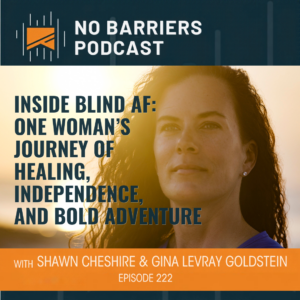
Ep 222 Shawn Cheshire & Gin LeVay Goldstein
Didrik Johnck: A question for you. What happens when the world says you can't, and you simply ask, "But what if I can?"
In this episode, Erik Weihenmayer goes behind the scenes of the bold new film Blind AF with guest Shawn Cheshire, whose story is at the heart of it. Alongside Gina Levey Goldstein, the film's director, Shawn shares her journey around the raw, unfiltered experiences that shaped not just the adventure captured on camera, but the life and resilience that made it possible.
Whether it's the technical realities of riding solo as a blind cyclist or the personal challenges of trauma, healing, and independence, join us and experience Blind AF from the inside out.
All right, let's do this. I'm producer Didrik Johnck, and this is the No Barriers Podcast.
Erik Weihenmayer: It's easy to talk about the successes, but what doesn't get talked about enough is the struggle. My name is Erik Weihenmayer. I've gotten the chance to ascend Mount Everest, to climb the tallest mountain in every continent, to kayak the Grand Canyon, and I happen to be blind. It's been a struggle to live what I call a No Barriers life, to define it, to push the parameters of what it means.
And part of the equation is diving into the learning process and trying to illuminate the universal elements that exist along the way. In that unexplored terrain between those dark places we find ourselves in and the summit exists a map. That map, that way forward, is what we call No Barriers.
Erik Weihenmayer: Hey, everyone. Welcome to the No Barriers podcast. This is Erik Weihenmayer, and, Gina and Shawn. We are so psyched to have you on the podcast. New film coming out, October 28th, I think you're releasing the film. It'll go into film festivals and, uh, and the different streaming services. The title is Blind AF.
Gina, you are the director. I read an article, and it said AF stands for what you think it does, and I was like, "I don't know what it is." What is it? I do know now, actually. I'm setting you up, but I just want you to say it. This is not a podcast for children.
Gina LeVay Goldstein: Well, the film is not either. no, it's, uh, it's, uh, blind as fuck. Very bold, like Shawn.
Erik Weihenmayer: There you good that'll keep us going throughout the whole interview now.
Gina LeVay Goldstein: Yeah, I mean, everything kind of snowballed, right? Like, I first met Shawn in 2015 actually, when I was doing a, a project for ESPN on female veterans, and her story, you know, stuck with me back in 2015.
And in 2019, I was thinking about Shawn, and I was like, "What was," you know, "What is she up to?" And I Googled her, and I fou- she, she just crossed the Grand Canyon, for the first blind woman to do the rim to rim, and I was just so inspired. I was like, "Oh, I have to call Shawn and, and," you know, "reintroduce myself."
And I just asked her, I was like, "I think," you know, "you have a, a fascinating story." And at that point, I didn't know really a lot about her story, other than that she lost her sight a few years ago, was a single mother. and so the more I kind of got to know Shawn, I realized that her story just had so many different, different layers to it, and we kind of peeled it away like an onion.
And then she came to me in 2020... with this idea of riding her own bike across America. And I said, you know, "Wow, let's figure out how to film this, and maybe we can tell your story through this, um, this journey across America." And so everything kinda went from there.
Erik Weihenmayer: Amazing. So you just mentioned riding a single bike across America with your team, Shawn. And,like you and I share a lot of things in common, right? W- obviously, we're both blind. And so even as a blind guy, when I think about someone who's blind, who's totally blind, riding a single bike America on these busy scary-ass roads with big trucks by you that drown out all the sound for a moment, all your audio cues,it fills my heart with terror, I don't know how you do this. You, I,know, I rode a single bike blind for a couple of days, me and my friend Skyler. He put bread ties in his, in his spokes, and I followed him around a park, and then I f- we rode down the road, and I rode down the bike path for a couple miles.
But I never could relax. I was never relaxed 'cause I was just like, if I go like an inch off this paved thing, this paved trail, and I, you know, drop a foot and I hit a rock or a tree or something, it's, I could break my leg. so anyway, I guess the point being that like, I'm way impressed. Like, how the heck did you get this idea after, being a Olympic cyclist to ride a single bike across America?
Like, how did that dream start?
Shawn Cheshire: I think that,having lived sighted until I was 36 then losing my vision and then racing tandem, I think was surrounded by, sighted people that everybody just says blind people ride tandem bikes. I think that, you know- Sorry.
Erik Weihenmayer: There's your puppy
Shawn Cheshire: That's Nick. part of my, healing process through, the, my trauma work and PTSD work was learning how to have curiosity when it comes to life and, not feeling stuck. And So for me, having heard, you know, blind people only ride tandem bikes, not single bikes, I was like, "Yes, but if I wanted to ride a single bike, what would that look like?
How would we do it?" And it just started with curiosity, really. and plus I didn't want, I didn't want society around me to tell me what I could and couldn't do. I wanted to be able to figure out what my own limitations were
Erik Weihenmayer: So explain the mechanics, Shawn, of how you do it. So because a, a sighted person's looking at like au- at visual cues, right? Like in the distance and up front and so forth, and they're able to keep a s- very steady line. Without that visual reference, you're not able to do that. I think you have a person on each side of you, I understand?
Shawn Cheshire: The skill of following sound started 'cause I did parabiathlon. So when you cross country ski race, your sighted guide is skiing in front of you with a speaker on their back, and they're wearing a, a microphone, and they're either giving you feedback or, or, and you're listening to their breathing and you're following that. So that skill started with parabiathlon, and so then we kinda used the same speaker microphone on a bike. plus we put a speaker for music 'cause if there was constant sound, even when Jesse wasn't speaking, then I had a point of reference of what to follow. And then, and then we discovered two-way radios, which made a big difference 'cause then I could communicate back to Jesse.
But it was really just me listening to feedback he was giving me. He was giving me feedback about where I was behind him to the right, to the left, though from a audio perspective, I could tell, where I was just based off of the music. and that's just kinda how we started the practice
Erik Weihenmayer: Yeah
Shawn Cheshire: figuring out how to do that.
Erik Weihenmayer: In the film, these big trucks are flying by you, and they,and the, the film does a really good job showing how they just completely drown out every bit of your audio cues for a minute. That must have been the terrifying piece, right? when that, tho- those audio cues that you're relying on are completely evaporated for, I don't know, a minute
Shawn Cheshire: Terrifying. There were a couple times I actually s- pulled off to the side of the road and stopped, because I couldn't hear,
Erik Weihenmayer: Heck yeah
Shawn Cheshire: had no point of reference where to go
Erik Weihenmayer: you're double blind.
Shawn Cheshire: I am double
Erik Weihenmayer: Yeah
Shawn Cheshire: yes.
Erik Weihenmayer: So you also bike on mountain trails, which blows my mind. so I've met Daniel Kish, and him and his... I should explain who he is. He's a blind guy who echolocates,to the nth degree in a way that he can ride a, a, a mountain bike down a trail, and he can echolocate trees and rocks and things like that, and boulders, b- big walls on one side or the other.
And I just would have thought that is impossible, too. Obviously, not for you. You, I think you did a huge race through Canada on trails and fire roads and things like that?
Shawn Cheshire: Yes, we did the Tour Divide bikepacking race from Banff, Canada to the Mexico
Erik Weihenmayer: yeah. Okay, so you did the divide. Okay, got it. Amazing
Shawn Cheshire: yeah. I should have died about 97 times on that bike ride. It was That was hard. I thought the road, the ride, the road ride across the country, was hard. And then when we did Tour Divide the next year, that was just a next level bike handling.
it
Erik Weihenmayer: Yeah, 'cause you're getting bounced all around by rocks and roots and, a- and trees and things like that
Shawn Cheshire: Oh yeah, and my guides were amazing. And sometimes they would just stand there and be like, "Shawn, we have no idea how to get you down this." And I'm just like, guys, do the best that you can and I'll follow you. pick the best route
Erik Weihenmayer: Yeah
Shawn Cheshire: let's just do it." Yeah, it was hard
Erik Weihenmayer: I could talk to you about that adventure alone all day long, but, amazing. We'll move forward. People can, in a way, like this web- this podcast is just giving people a taste of what's possible, right? so still remains a bit of a mystery how you have achieved these things,but at least that gives people a start to understanding it. Think if they wanna understand it more, they better go try it themselves. or, Gina, should we say, don't try this at home? Yeah, is that what... the moment when we say that to the audience
Gina LeVay Goldstein: Don't try it at home. I mean, or try it, you know? Listen, I think in the spirit of the film and Shawn, it's like you should try it. Actually, we were, we were, um, in Colorado when we were passing through, the country and, um, we met with some people from Team Red, White and Blue. Um, then Shawn, um... It's m- People who don't know what it's a m- Um, it's like a, a, an organization for veterans, and they really promote, like, wellness after d- uh, deployment.
And so we met, a, a young guy who was totally blind as well, and he was doing a tandem. And Shawn basically was , like, "Here, why don't you try it?" She gave him, uh, the Sena helmets with the two-way radio. And he was amazing, is, And he went on, like, crazy Colorado. I for- I forgot the road it was on, but it was, like, outside Denver or Colorado Springs, and he just, like, went full on in.
And we were all just in awe of, of his just, like, just, you know, bravery to be able to do that. And he did, he did a good job, right, Shawn? Like, I think he was ... We're, th- You're like, "Come on, let's do it." So
Erik Weihenmayer: Shawn,
Gina LeVay Goldstein: you never know.
Erik Weihenmayer: to open the door for other people like that?
Shawn Cheshire: Absolutely. I feel like, especially like when I meet the kids, is that's the future and it's just empowering to be able to make your own choices as to what you wanna do and what you don't wanna do, I believe
Erik Weihenmayer: Yeah. Gina, what originally im- impressed you by Shawn's story? like what was the initial attraction? I understand you guys are both, moms, of course,Shawn being a, a single mom. but y- you had a newborn, when you met her, so there was
a
Gina LeVay Goldstein: connection there.
Erik Weihenmayer: But, like what was the gut reaction
Gina LeVay Goldstein: Yeah, I think that was it.
Erik Weihenmayer: a great story,"
Gina LeVay Goldstein: yeah, I think, um, when I, when I first met her, I, I just had my second child and, uh, so this was during the 2015 ESPN interview, and she was just describing how she lost her complete sight when she had two young children at home. And so one, I was just struck by that. I was like, "I can't imagine how you could do that."
and s- and she had no support. She was a single mom. And then the fact that she battled so many demons afterwards, didn't wanna leave the house for, you know, six months when this, when the accident happened, and then she decided to, in three years,qualify for Team USA, which was kind of unheard of.
So I think I was also just really... In cycling and para-cycling. And so at that time, I just thought she was an extraordinary human, really, to be able to, to take what life gave her and, and, d- had, decided that she wanted to, she had a choice to, to live a way she wanted to live, and I thought that was just so amazing.
And then when I reconnected with her, I started also, you know, learning more about just the fact that losing her sight was just one trauma, traumatic event in, uh, in her life, and not just, you know... B- before she lost her sight, she suffered a lot of other trauma. And so I think I connected with her on that in just, in, in just r- figuring out how, how you kind of heal yourself, uh, from trauma to really find your authentic self of who you're really supposed to be in this world.
that's I think what really compelled me to tell her story, because I think a lot of people can relate on different levels of her story, and I really wanted to, uh, figure out how, how to tell her story in an authentic and true light, and that was my goal from the beginning.
Erik Weihenmayer: Yeah. Shawn, so forget cycling and climbing and all the things that you do. Gina was mentioning you as a single mom. a blind single mom, that's rife with challenges. tell us about the challenges of that, of being, of raising two kids a blind person
Shawn Cheshire: I think back then the, the hard part in retrospect is we're all going through a g- we're all going through grief in, in different ways and adjusting to a new norm I ju- I didn't know what to do. I didn't know how to help them. I felt eh, especially the first couple years, that I was just drowning, myself in my own grief. and it was really hard for me to figure out how to show up for my kids back then. And I think that my kids are a big reason as to why I chose to live, as opposed to taking my own life, and not living like this is, our- we come from such trauma that I knew that the only way that my kids were really gonna learn what it looks like, how to take care of yourself after going through really hard things by how I choose to live and how I choose to take care of myself. So it was kinda like I had to make this mental, emotional shift then to care of myself in a way that would model the behavior for my children of what that looks like. And when I did that, o- obviously, you know, it helped me to be able to be more present with them.
Erik Weihenmayer: Yeah
Shawn Cheshire: And it was really hard. They, it, they'll tell you, it was really hard for them to watch me go through that.
And as children, their brains really weren't equipped to process all of that. And so it really has been this up un- even to today, this process of togetherness,through, through all of it, through the, the trauma work, the recovery, the blind- adjusting to being blind, now hearing loss, and
yes.
Erik Weihenmayer: And your daughter and you have a great relationship. I saw her in the film.
so you guys have a close relationship, which I find pretty amazing considering, the struggles that you obviously had as a mom, when they were younger. I think I heard you just say that they sensed your struggle as a mom, so they were as kids your struggle, not only from blindness, but from some of the traumas that you'd experienced
Shawn Cheshire: Oh, yes. Yes. And I'm very close with both of my kids. but I'm also very vulnerable with them as well as like I'm I ...you know, I have the capacity to sit here and listen to how it back then, when I was struggling with vision loss and losing my job and how it just really impacted our lives, was a sense of abandonment there for them. And so the ... One of the most healing things I can do for them as mom is being able to sit there and listen to how it affected them with no judgment, no defensiveness, just openness to listen to that, and that really I think that really helped them. It kind of bridged this gap between me and my children from when they were younger and I lost my vision.
Erik Weihenmayer: And you also, it was clear in the film that you grew up in kind of a loveless home as a child yourself. so you really, as like a mom, didn't really have lessons on motherhood, on how to be nurturing. so you're like learning all this stuff from scratch as you're e- experiencing newly blindness. I mean, come on, that's a lot
Shawn Cheshire: Yes, I had no idea what I was doing as a m- young mother, that is for sure.
Erik Weihenmayer: Well, not, most people don't, but most people don't have those ditches to climb out of y- like you did
Shawn Cheshire: Yeah. No, my, my childhood was absolutely loveless
Erik Weihenmayer: Yeah.
Shawn Cheshire: Yeah.
Erik Weihenmayer: So I have a c- another question for you, Shawn. seems like independence is a really important word for you, right? Other maybe blind people ride tandem bikes 'cause that's what's expected, but I wanna ride a single bike, or I wanna hike the Grand Canyon solo, without that support. But at the same time, you have people, like, in the background watching out for you. On your bike, you have person on each side of you, or you're listening to the radios. and so you are, in a way, still dependent on people. In a way, you're interdependent, right? You're still dependent on this, network of friends and supporters. So is that a contradiction, or the two work together? How do you see that?
Shawn Cheshire: Well, the way that I make the, my decisions on what I do and how I do it I weigh the benefit versus the harm and allow myself the curiosity, but not to the extent... I do not have a death wish, so I'm not... After all the, all, everything I've lived through and how hard I've worked to be who I am today, I'm not flippant with life and my life.
And so I try to out- I try to weigh the benefit versus the harm, and I always like to have some sort of, a safety net, 'cause the goal is to try to do the thing, but it wasn't to die trying to do the thing. 'Cause it wasn't about that? It
Erik Weihenmayer: Good point. Yeah
Shawn Cheshire: It wasn't about the ultimate sacrifice of, "Oh, Shawn couldn't cross the Grand Canyon solo because she died.
she slipped, fell off the edge and fell to her death." It was,
Erik Weihenmayer: That would backfire
Shawn Cheshire: about... It w- And, but it was, it's all about the trying, right? It's about testing the limits, pushing the boundaries, and just seeing what I'm capable of and what I'm not capable of. But it's never about the sacrifice of life to me. and But I'm not real sure what you mean by interdependent when you said that
Erik Weihenmayer: Well, people depend on you too, right? they're depending on you to, to, to,to ride a straight line and to, to be listening and to be a good team member. And, when you're hiking the Grand Canyon, if they're yelling down from above you, "Hey, stop. There's a mountain lion." You know what I mean?
Like, there... A lot relies on you, so there is a dependence back and forth
Shawn Cheshire: Yes, absolutely.
Erik Weihenmayer: Yeah. And trust, right? if you were untrustworthy, these people would not be partnering with you.
Shawn Cheshire: Correct. 100%. Jesse Crandall will tell you that on the bike.
Erik Weihenmayer: Yeah.
Shawn Cheshire: Yes
Erik Weihenmayer: often, like I joke around sometimes and I, and w- when I am climbing a mountain, of course I'm relying on my team to guide me and talk to me and stuff. But I always say, I wanna be a real part of the team. I, like I don't wanna get dragged to the summit and spiked on top like a football.
So I kinda related to what you were talking about because you wanna do these things in a way that feels true and authentic to you and your life and your pursuits, right?
Shawn Cheshire: Yes, a hun- yes, absolutely. Authenticity is so important
Didrik Johnck: No Barriers would like to recognize and thank CoBank for their support of No Barriers. Since 2016, CoBank has provided access to our life-changing programs for veterans and family caregivers from rural communities. CoBank is one of the largest private providers of credit to the US rural economy. The bank delivers loans, leases, and other financial services to agribusiness, rural infrastructure, and farm credit customers in all 50 states.
If you live in a rural community or work in agribusiness, we want you to know that CoBank supports this kind of holistic support for your community
Erik Weihenmayer: Gina, as the director, you committed to this thing. You're watching, Shawn struggle,some close calls with cars and things like that. it made me think of, that famous movie with Alex Honnold, Free Solo, where this film crew, sets up around him to solo El Capitan, and they might be watching a guy die that day.
And like,
what do you do, right? And,
Gina LeVay Goldstein: it's true
Erik Weihenmayer: So how did you balance that risk? 'Cause I mean, that's... As a filmmaker, you're like, "I don't really wanna watch somebody die or go flying off a cliff," and,
Gina LeVay Goldstein: Yeah. I think that was just the unknown, right?
Erik Weihenmayer: Yeah
Gina LeVay Goldstein: we, didn't know what to, what was gonna happen, and I think because of that
Erik Weihenmayer: fell and, and banged her head again, she could lose her speech, her mobility, her life, right? So it was real consequences
Gina LeVay Goldstein: Yeah, and I think, I think we all kinda went in it wanting to document this as real as possible, and I think I, I'm always just in awe of Shawn's vulnerability and trust she gave me in this whole process. Because Shawn was very much like, you know, unless there's ... U- unless I say no, or, you know, like you can kinda have access to the, the good, bad, and the ugly.
And she trusted me in, in, with all that information to kinda make this, this narrative. So when we were riding across America, I think we were always like, "We have to be there for every moment."
Erik Weihenmayer: Yeah
Gina LeVay Goldstein: It was impossible, but like, you know, we had a lot of footage because we didn't know when, yeah, she might have a close call with a truck, or when she would, you know, wha- when are these moments?
And so we really tried to kind of be there as much as possible, especially when she was on her bike. Um, not to miss it, but I think also for us, the, a lot of the great times, I think that, that, uh, was off the bike, you know? Um, and I really wanted to have a sensory experience for Shawn of how she would experience, um, America.
'Cause I think for sighted people, when you're, you're seeing the film and like you're seeing Shawn, and she's a really skilled cyclist, so she can ride straight, you know? But you're also being distracted as a sighted person with, you know, beautiful scenery of like the Tetons or, you know, we're, you know, g- going through these, you know, fields of wheat.
And, and you kinda lose this, lose track of the fact that like Shawn is not experiencing that at all when she's on the bike, right? Um, she's just listening to sound. It's just, it's just the pressure, vibration, sound, her own-
Erik Weihenmayer: focused. She
Gina LeVay Goldstein: super focused.
Erik Weihenmayer: to
Gina LeVay Goldstein: Right
Erik Weihenmayer: around at the beautiful mountains.
Gina LeVay Goldstein: Right. And I'm sure you,
Erik Weihenmayer: couldn't do
Gina LeVay Goldstein: yeah.
Erik Weihenmayer: Yeah
Gina LeVay Goldstein: No, but even still, right, the, the moment of like, "Oh, let me just breathe and take in everything," or the...
Right, like that's not what's happening. I'm sure, you know, Erik, you relate to this. But uh, so yeah, so for... I really wanted to find those moments where she could breathe, where she could smell the wildflowers, where she could talk to people, where she could hear the horses, touch the horses. Like that was really important for me as well, you know, to, to be there for those moments, um, for Shawn.
And then also for her more, I think, inner journey that the film talks about too. and that's, that, you know, happened after the Ride Across America
Erik Weihenmayer: Well, that is clear in the film that there's this interplay, and we talk about, a lot about this at No Barriers. There's this external journey and then there's this internal journey, and they're happening at the same time, and they coincide usually. they work against each other and with each other, right?
So you are ... That was obviously i- intentional, as you were telling the story
Gina LeVay Goldstein: Y- yes, definitely.
Erik Weihenmayer: Yeah
Gina LeVay Goldstein: 'Cause there was obviously more. You know, there, there was a reason why Shawn wants to do these, extreme adventures, right? There is that internal journey that's actually fueling it. Like, not just breaking barriers, but there's a, you know, something more,
Erik Weihenmayer: Yeah
Gina LeVay Goldstein: and Shawn can speak to about it that, propels her to keep on doing this and why
Erik Weihenmayer: Yeah. Shawn, I have a question for you. So, um, you went blind from cortical blindness. Really interesting. not... Interesting maybe is the wrong word, but, wild that, you got slammed against this ambulance as an EMT, you... And so your problem is not in your eyes, it's in your brain. It's a part of your brain got damaged. I was blown away by the part of the story where a lot of people didn't think you were really blind. Like, people thought you were cheating or something like that. I was like, why are people, like, testing you out to, like, prove or disprove that you can see?
What was going on there?
Shawn Cheshire: I can only assumptions, on their part that I think because, I think because when I lost my vision and became an athlete, and I had this internal process going on in PTSD and trauma work And they were, and curiosity became a thing for me, and I think because I'm just, different. I, I present different. I look different. The curiosity makes you different. And, and I just think that some people who insecurities or fears, I don't... i, you know, the only thing I can do is, is try to understand it in my own way of why people would be like that to me is you know, I feel like when you look at the history of bullying, it's usually fear-based,
Erik Weihenmayer: Yeah
Shawn Cheshire: whatever that difference is that people are uncomfortable or scared of, that's, that's the only way that I can rationalize that. I don't... It was heartbreaking. It was,m- it w- it actually... I never in a million years thought that was a thing, even in the world of disability.
And it's interesting. I raced with Team USA for seven years, and I was accused of faking it the entire time. But when you race for Team USA, you have to get classified by three international doctors every year, and you have to present medical documentation that classifies you without a doubt that they then approve so you can race.
And so every year I went through that process, and every year there was never an issue, but it, it didn't seem to matter. They s- you know, Because I pushed the limits of what they thought a blind person should look like or do or be curious about, I think that's really where the conflict was
Erik Weihenmayer: they have to go to the lowest common denominator and like m- mistrust everyone, which is really sad, isn't it? But be fully transparent here and, I noticed that Lonnie Bedwell was at the end of your documentary, who's a good friend of mine. We kayaked the Grand Canyon together.
So I went down the Grand Canyon and kayaked some of these gigantic rapids in my own kayak, and then when I heard that Lonnie had done it, I was like, "How did another blind guy do that? It was so hard. Like, he must be able to see." that was my first thought. I'm being fully
Shawn Cheshire: Aha
Erik Weihenmayer: I'm telling you, I'm being such an asshole, and I know that was such an asshole thought, but I t- I
That's what I ... my first thought was like, he's gotta be able to see a little bit." And then I realized in my own brain, I was like, "Erik, that's not the right way to think, right?" that's ... you gotta ... you're a door opener, right? you wanna be happy and want people to walk through that door, and Lonnie's a badass.
Sometimes other blind people I imagine, because of their own ego and jealousy, might be questioning you, right?
Shawn Cheshire: Sure. Yes, absolutely.
Erik Weihenmayer: Yeah
Shawn Cheshire: you know what? That's okay. I don't really have a problem with that part. Like, I want people to be curious because it's there in that curiosity that people will start questioning, if she's really blind and she figured out how to do this, what am I capable of? what can I go out there and try?"
And that's the whole point of that.
Erik Weihenmayer: Yeah
Shawn Cheshire: Yeah
Erik Weihenmayer: Shawn also, so you... I was trying to think about how to s- phrase this, but like you have had the triple whammy of trauma, right?
Shawn Cheshire: Yes
Erik Weihenmayer: a less loveless, parents and parents that just didn't know how to be parents. You had an abusive marriage, horrible marriage, going blind, right? it's fair to say that anyone in that situation would be angry, would be massively depressed. I've seen folks, a lot of vets that we work with, at No Barriers, and so many tough things have happened to them. I thought if you crawled under a rock, and said, "Hey, this world sucks," nobody would blame you, right? But you chose a different approach, right? You chose a different approach. You didn't do that.
I mean, that would have been a- almost a natural, more expected thing to do. so talk us through process of your own healing. Like, what was that process like? what do you think the keys are for people? Because obviously, just getting on a bike and riding across America doesn't fix you. That doesn't heal you instantly, right?
I think that's a cheap way to think about it. It's just a piece of the equation of your own journey, right?
Shawn Cheshire: Ye- 100%, yes. So I actually tried to kill myself, in the first two years after my injury twice. And, I think that, 'cause sometimes people ask me, what am I running from or, why do I need these adrenaline rushes? And, really what happened was is that when I really started getting into the trauma work, and really about how the traumas I'd lived through affected me, I will never forget my first trauma doctor when, when we were just talking about how just absolutely unhealthy dysfunctional I was, from a statistical perspective, when you look at my parents and my childhood alone, outside of the abusive marriage, I was destined to be a drug addict, alcoholic, like some sort of addiction, um, you know, prostitute, or dead.
like the statistics, were heavy in that favor. I remember that she looked at me and said that, know, this is what research shows, but the reality is that I actually can choose who I show up as every day, that my past and what I've lived through does not have to define me, that I can actually choose to be who I wanna be. And to me, that was the biggest fuck you to my parents that I could think of, to not succumb to where society or statistics would say I would become, but to choose a path that goes against all of that, and to be someone that I could be proud of, that has inte- integrity, that, lives a life of if I never said a word, people would know who I am and what I'm made of.
to me that was so much more, attractive to me to do that back then that I made the decision then that I was going to work as hard as I could work to be the healthiest person that I could potentially be, to learn to be a great mother, healthy parenting, like all of it. I chose all of it.
And then what happened in that process was sports gave me a place to put the pain, and the sadness, and the struggle that I was living and grieving, right? My life is like this one consistent grief process, and the activities, the, the hiking, the biking, the racing, everything, all of that just gave me a place to put that. So instead of being stuck and sitting and, percolating in it with no movement, the movement actually gave me a place to put it. And that in itself is, been my healing process, is the movement
Erik Weihenmayer: That's so fascinating. I can only speak to my own experience. Of course, I feel like the things I do, the adventures I do are in celebration of what my possibilities are and what we can achieve together as friends, doing cool things together. like I kayaked for 10 years, pretty, pretty big rapids and things like that, and even to this day, when I walk by a river with big rapids, gets a little butterflies in my stomach, right?
Little... I almost feel like I'm like, ooh, I'm a little nervous just listening to a rapid. And so sometimes these things that you do, there's a... bordering on healing, but also re-traumatizing you.
Re-triggering that trauma, bringing it right back to the surface. Is that a good thing or a bad thing?
Shawn Cheshire: this, that just takes me back to the conversation of, at, where I have to do this internal conversation of the weighing the benefit versus the harm. what would the benefit be if I do this versus the harm if I do this?
Erik Weihenmayer: Yeah
Shawn Cheshire: Yeah, and then, and that's something that I take seriously and
Erik Weihenmayer: But I'm sure you had been re-traumatized, some of those things that happened to you. I could see it in the film. bringing everything right up to the surface for you again. So in a way, is that maybe part of the process too? not "Hey, I'm gonna avoid life. I'm gonna, I'm just gonna live this safe life."
I'm gonna, I'm gonna l- live life fully, and sometimes that means I'm gonna be re-triggered, and I have to learn to deal with that process
Shawn Cheshire: yes. 'Cause one of the things that I learned is that triggers is an indication of places within me that I need to tend to still,
Erik Weihenmayer: Right
Shawn Cheshire: It's places for, to, sends me back to paying attention to it. There's more work to be done here. and I'm okay with that because for me, that means more growth, more evolution. and it's also taught me that when I re-traumatized and these old feelings come up in my body, it gives me an opportunity to show up for myself, to say, "Hey, you're okay. You're safe. I got you."
Erik Weihenmayer: Good for you. That's awesome. And let's talk about transitions for a minute. You go from the military, I mean, this tough childhood to the military, to single mom, to blind, to Olympic cyclist, to, you know, person who hikes and climbs. how hard are these transitions? I speak for a living, you know, and, and I'm always talking about, transformation and change and growth and, like, but when I look into my own life sometimes, like I hate change.
I hate transitions. I freaking hate it, right?
Shawn Cheshire: Mhm.
Erik Weihenmayer: advice for people that are, going through these transitions, massive dramatic transitions where, you know, it's like endings and renewals constantly over and over throughout our lives?
Shawn Cheshire: this is where I get a little weird. You might think I'm weird when I say this, is that I had to change the way that I see change. I had to think of change as an opportunity for growth and evolution into becoming, the person that I wanna be, my best self. And so I actually love change. I embrace it. I... sometimes,it's har- it's hard, and there's this whole process that comes with it. It's just that I don't... I seem to have no control over the things that are, that happen to me in my life. There, don't have control over that aspect, and I don't have a lotta energy to put into worry there. So what I do is I just try to focus on the things that I can control, which is me, and what do I do with the change? You know, what do, what can, what, how can I use this? What can I learn from it? Everything I experience, I go into it thinking, like especially with this hearing loss is just, this last year is Like unbelievably hard and it makes me so sad.
Again, I'm, I feel like I'm back at this place of like how am I gonna live like this? And then it's what can I learn in this? What can I, who am I supposed to be through this process of learning how to live blind now, very hard of hearing. And, and so I try to just stay open to that.
I mean, I have my days. I wake up and I'm emotional, but it's like I have to give myself boundaries. It's like, bitch you got 10 minutes to cry and then you have to get up and face your day. And then I get up and I face my day, and when I look back at that and I realize like I could have stayed in bed all day and I could have just wallowed in it or percolated, and then I'm very grateful that I pushed myself through that to face another day.
And I just, I try to just kinda do it moment by moment, and focus on the things that I have actual control over and realizing ... Like I have conversations with the universe 'cause I'm like, "I feel like the universe hates me some days." And I'm like, "Come on , like what else are you gonna throw at me?" but I try not to sit there for too long.
You know? I try to, really try to put my effort into really focusing on the things that, I have control of, which is really me.
It's my attitude. It's what I can learn. It's how open I can be. I cry. I'm sad. I write. exercise. Like I ... And movement keeps me feeling not stuck, And I love to give myself choices.
So these are like all these things I've created around me in my life that help me in this every day.
Erik Weihenmayer: Shawn, I really love what you're talking about, like you give yourself 10 minutes to cry. I interviewed this really amazing lady, who was a mom and had a, a, a child who was disabled and, he'd look out the window at the kids playing basketball and feel really bad and cry. And, uh, she would have these things, she'd call them pity parties, where they'd be like, "We're gonna sit down today, we're gonna watch sad movies, we're gonna eat pizza, we're gonna cry, and then we're gonna pick ourselves up and we're gonna get out there in the world."
So I think you're pointing out something really important for people. don't avoid that piece of pity for a minute, but don't linger there, right?
Shawn Cheshire: Right?
Erik Weihenmayer: And then, I'm watch- you mentioned your hearing loss, which I think you got some of that on Everest. And so I'm watching this documentary or listening to it, and I'm like through this intense adventure.
I'm like, "Oh my God." And then I, fucking A, I see this lady climbing Everest. Like, what the... I was like, "What? How, how did I miss this?" So that's amazing. Are you gonna, You fell short because s- because you were having migraines and things like that, and, I hear you're gonna go back? Or is it you're just still deciding?
Shawn Cheshire: No, I wish I could go back, 'cause what happened is thought it was brain injury, like migraines, but what happened was is after two attempts to getting t- past camp one, I came back to the States and I was deaf.
Erik Weihenmayer: Oh my gosh. Must have been scary
Shawn Cheshire: I've ha- I've had four ear surgeries then, and, I wear hearing aids and I have...
And plus being a brain injury, like I th- I, I don't know if you remember Charlie Brown, the teacher,
Erik Weihenmayer: Yeah.
Shawn Cheshire: on the cartoon.
Okay,
Erik Weihenmayer: wa
Shawn Cheshire: I have lost structure. Right, I have lost structure to words. I'm in speech therapy, I'm doing like this auditory processing, it's like the combination of hearing loss, So the level of hearing, but it- there's also this huge, cognitive component that was also damaged. I, my brain just doesn't recognize a lot of things, and I go through conversations with content. If you threw a random statement out there to me, I probably would have no idea what you're saying. And I have a right side delay, so I don't hear all the w- the whole, the entire word of any word, so my left ear is kinda trying to pick up the slack.
But all of this happened from extreme altitude, and I had no idea, that's what was happening at the time.
Erik Weihenmayer: So now you're on this new transition, right? This new, this, this renewal of this new adventure that you're on that you didn't ask for. So speaks to what you said a moment ago
Shawn Cheshire: Yes, it, and it's so hard. it's so hard. Hearing loss with vision loss is so hard.
Erik Weihenmayer: I can imagine
Shawn Cheshire: yeah
Erik Weihenmayer: My dad had a stroke, years ago, and, my dad was like you, where, after his stroke, we went to the hospital where he was rehabbing, and he was, like, on the treadmill, and he was, like, doing all this stuff, and he's "This is a fascinating process to see how the brain can rebound."
And I'm like, "Nobody l- Dad, nobody looks at a stroke like that." like this great adventure, that I'm on now to, to see what a... how I can remap my brain. And I'm like, "Oh my God, Dad, you're, like, a weirdo
Shawn Cheshire: I, oh my goodness, I relate to your dad.
Erik Weihenmayer: Yeah
Shawn Cheshire: That's the way I think about it
Erik Weihenmayer: That's so cool. That's a good way to look at it, right? Because otherwise, it's too much. Shawn, I saw this article about you doing the rim-to-rim on the Grand Canyon, which is amazing. I hope this doesn't sound like bragging, but,I actually did that in, the rim-to-rim-to-rim in 1993 with my friend Kevin. Uh, hiked from one side back again, and it was about 24 and a half hours. I think we broke 25 hours. The reason we didn't partly was because, um, I, uh, we stopped at that cantina and had a beer on the way down, was like the stupidest thing, and that just destroyed our energy. And I remember hiking out of the South Rim, and there was like, I could barely keep up with this Girl Scout troop. And then so I'm like, really cool that Shawn did that, and then I realized, holy shit, she did not do this, like I did, like with a guy ringing a bell in front of me. You did this solo. Like, your friends were way back there, and you were hiking and navigating that trail by yourself, which is a whole 'nother podcast that we can focus on down the road.
But a- another truly amazing, groundbreaking accomplishment, Shawn
Shawn Cheshire: Thank you.
Erik Weihenmayer: Oh, and you and I have something in common. We both love peanut M&Ms on our hikes. Yeah.
Shawn Cheshire: yes.
Erik Weihenmayer: Yeah
Shawn Cheshire: Yes. we should talk about the Grand Canyon sometime 'cause there is a reason why I did that
Erik Weihenmayer: you can, if you, y- yeah, tell me
Shawn Cheshire: Okay. my, I ha- I do a lot of work up at NAU here in Flagstaff, Arizona with the sports science kids, with the f- my friend Scott Drum. Scott had traveled to Europe for a conference, the fall before I went to, Nepal to climb Everest, and he had a meeting with, Reinhold Messner. And they ... And your name came up in the conversation about how amazing you are, the first blind person to summit Everest.
And then, know, Scott was gonna mention like my friend Shawn, who's blind, woman, is gonna attempt to summit Everest. And Reinhold Messner made a statement that, blind people will be ... are more like tourists because we always need a guide, and we don't do anything alone. I was like, "Why in the world would you say that?"
And for me my brain is about we ... Nobody should limit anybody, and that if some- if any of us, blind or not blind, wanna do something,who's to say that we could or we couldn't? And so for me to do the solo crossing of the Grand Canyon was just a message of what ... it is possible to do something alone as a blind person.
we d- we're not tourists, we don't always need a guide. But then I did have that safety aspect 'cause the ... I wasn't trying to die. I wanted to just see if I could do it, and I was able to do it, so which was amazing. but that's the only reason why I did that
Erik Weihenmayer: It's disappointing when our heroes say things like so flippantly, right? Yeah. I've ha- I have had that as well with some of my climbs. so
Shawn Cheshire: Yeah
Erik Weihenmayer: I wanna get this quote right, 'cause I really like this last quote. it said The reason you do these things, a- and the quote was, "A chance to exist outside the contradiction of possibilities."
I think that's really cool, right? so is, does... kinda sum up why you're doing these things, to kinda break out of the... It is a contradiction, right?
Shawn Cheshire: Yes. Yes, it is.
Erik Weihenmayer: I'm glad you threw the word contradiction in there, right? Because life is full of contradictions or things that don't seem like they should work together
Shawn Cheshire: Right. Right. But I feel like each of us should make that determination for ourselves, not anyone else.
Gina LeVay Goldstein: Yeah. you have done that. so Gina, what's next with the film here? What's the plan? Tell us,Sure
Erik Weihenmayer: cool update to, to lead us out of here
Gina LeVay Goldstein: Yeah. Well, we're excited. Um, October 28th, the film will be available on, on Prime Video, Apple TV, Documentary Plus, and other platforms. So just, soon, uh, you guys will be able to see Blind AF, and see, hear more of Shawn's story. and
Erik Weihenmayer: for again?
Gina LeVay Goldstein: Blind as Fuck. But see, now you ... But see, making not only ... Sh- Shawn was actually really behaved, um, this podcast.
But she's usually, usually she has a lot of F-bombs, But, um, so there's that. But also I think the, the reason why we also liked the title was because I think it's also like an F you to trauma, to things that are thrown at you. F you. we're going forward, which is really what I hope people take away from the film is just keep on moving forward,
it's, you're not gonna ... Just move forward and figure it out, you know? So
Erik Weihenmayer: you two so much. It's been amazing conversation. I've learned a lot personally. I always think to myself, like, even if nobody was listening, I'd still do these podcasts because it just gives me a chance to meet fascinating people who've just broken through all kinds of barriers and pioneered all kinds of new things, as we said, both externally and internally. it's been a real p- pleasure and privilege and,
thanks to both of you. No barriers to everyone
Didrik Johnck: The production team behind this podcast includes producer Didrik Johnck, that's me, and audio engineer Tyler Kottman. Special thanks to the Dan Ryan Band for our intro song, Guidance. And thanks to all of you for listening. If you enjoyed this show, please subscribe, share it, and hey, we'd be thrilled for a review.
Show notes can be found nobarrierspodcast.com. There's also a link there to shoot me an email with any suggestions or guest ideas for the show. Thanks so much, and have a great day